
Two languages, twice the world
At Gökkuşağı Schools our students acquire a second foreign language at an early age alongside English. Dual foreign language education raises our children not only academically, but as world citizens able to communicate across cultures.
More than one language, a way of seeing the world
Dual foreign language education means the student learns English in depth as their main foreign language while also acquiring a second foreign language at an early age. At Gökkuşağı Schools this second language is Spanish, and it becomes a natural part of the child’s day from kindergarten onwards.
The most effective period for language acquisition is early childhood. At these ages children acquire a language not by memorising rules but naturally, through play, song, drama and real communication; their pronunciation comes far closer to that of native speakers. Research shows that children growing up with more than one language develop early the ability to see language as a system (metalinguistic awareness).
Dual foreign language means global communication, cultural understanding and a strong advantage in the future world of work. Our children come to know different cultures, develop empathy and look at the world through a wider window.
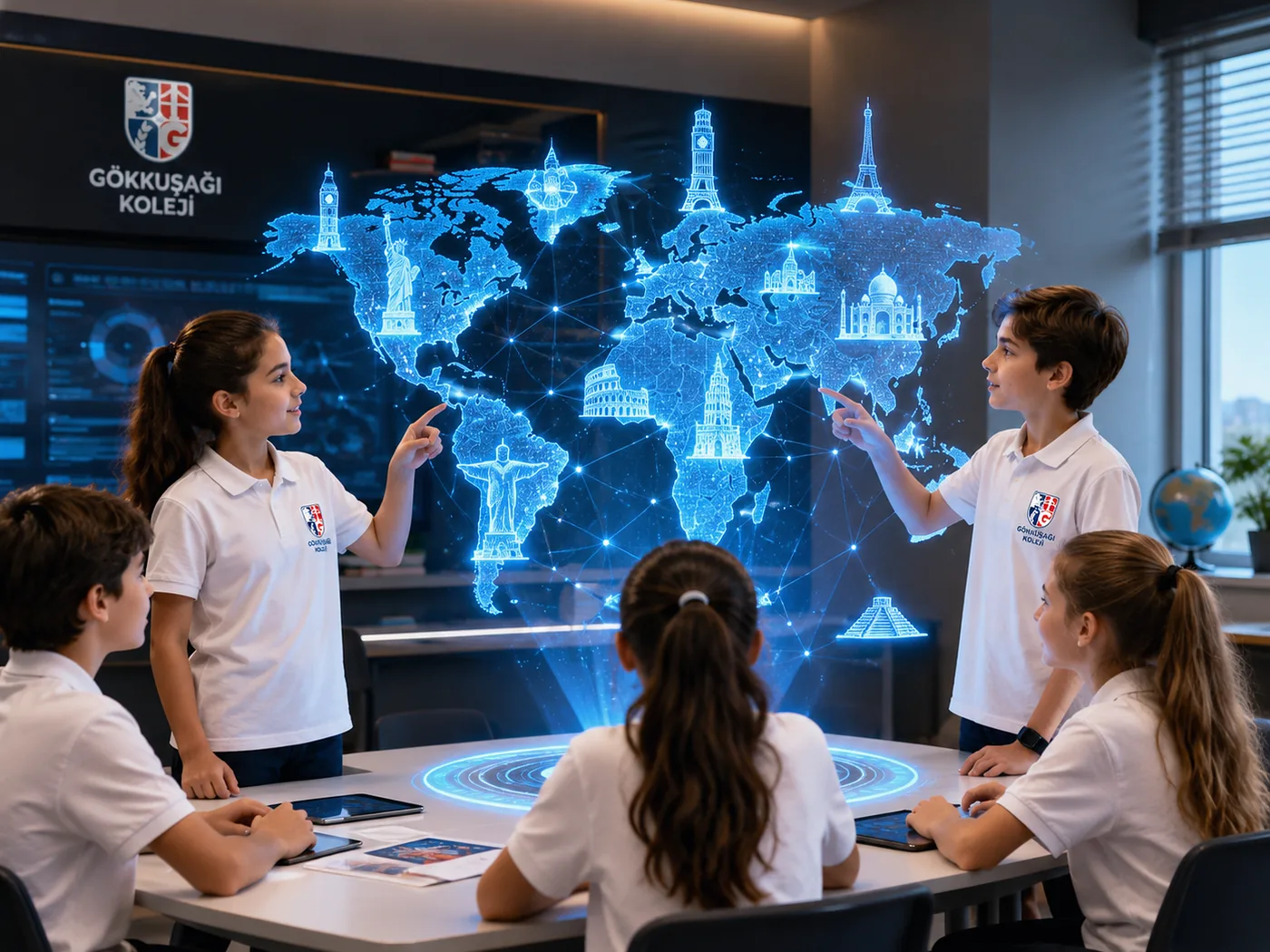
The three great gains of two languages
Global communication, cognitive development and professional opportunities; the three foundations that make dual foreign language valuable for your child.
- I
Global Communication and Cultural Understanding
Two foreign languages enable the student to know different cultures and communicate effectively with them. Empathy and a sense of global citizenship develop.
- II
Cognitive and Personal Development
Multilingual education supports focus, mental flexibility and analytical thinking. Research shows that early multilingualism strengthens metalinguistic awareness.
- III
Professional Opportunities
Multilingual competence is a clear advantage in a globalising world of work; it opens doors to international education and careers.
A brief overview of the programme
- 0Foreign languages together · English and Spanish
- 0Age at which the language journey begins
- 0Core language skills develop in balance
- 0Levels measured by CEFR · from A1 to C2
English and Spanish
A main foreign language and a second language begun at an early age; together they build a strong language profile.
English
First Foreign LanguageThe main foreign language, deepened through the Cambridge curriculum. Reading, writing, speaking and listening, the four core skills, develop in balance. Target level by the end of lower secondary: B1-B2 (CEFR).
Spanish
Second Foreign LanguageA second foreign language begun in kindergarten. Early acquisition of one of the world’s most spoken languages; target level by the end of lower secondary: A2 (CEFR).
From kindergarten to high school, step by step
Language competence deepens in a planned way at every level. You can see clearly where your child will arrive and at what age.
- Kindergarten · Ages 4-6
Kindergarten
English every day, weekly Spanish activities. Natural acquisition of language through play, song and drama; a journey that begins with love.
Natural acquisition - Primary · Grades 1-4
Primary
The four core skills develop in balance. An A2 target and Cambridge English Flyers in English; basic communication in Spanish.
A2 · Cambridge Flyers - Lower Secondary · Grades 5-8
Lower Secondary
Academic language competence deepens. B1-B2 in English and A2 in Spanish (CEFR) are targeted.
English B1-B2 · Spanish A2 - High School · Grades 9-12
High School
Advanced English and Spanish; academic content and preparation for international exams and certificates.
Advanced · certification
A measurable, internationally valid language competence
We set our language levels according to the CEFR (Common European Framework of Reference for Languages), developed by the Council of Europe and recognised worldwide. Ranging from A1 to C2, this scale expresses the student’s competence in an objective language that universities and employers understand.
Our students prepare for age-appropriate international exams: Cambridge English (Starters, Movers, Flyers and above) in English, and the DELE awarded by the Instituto Cervantes in Spanish. These certificates are lifelong, portable proof of the child’s language competence.
Dual foreign language questions answered
Our first foreign language is English and our second is Spanish. English is deepened through the Cambridge curriculum; Spanish is part of the programme from kindergarten onwards.
The second foreign language, Spanish, begins with weekly activities as early as kindergarten. Early childhood is the most effective period for language acquisition; at this age children acquire a language naturally, with pronunciation close to a native speaker’s.
No. At these ages languages are acquired not through rules but naturally, through play, song, drama and real communication. Children learn two languages at once, with ease and enjoyment; the process also supports mental flexibility.
CEFR is a language proficiency scale developed by the Council of Europe and recognised worldwide (from A1 to C2). It lets us express the student’s language level in an objective, international language that universities and employers understand.
Yes. Our students prepare for age-appropriate international exams: Cambridge English (Starters, Movers, Flyers and higher levels) in English, and DELE in Spanish. These certificates are lifelong, internationally recognised credentials.
Multilingual competence is a clear advantage in overseas university applications, international careers and the global world of work. Your child grows into an individual able to communicate with different cultures and to view the world from a broad perspective.
Let’s plan your child’s language journey together
Fill out the form and our advisors will call you about our language education, the targets by level and the admissions process. Dual foreign language education is delivered at all our campuses.
Explore international education up close.
Alongside our dual foreign language approach, explore our international programmes too; let’s find the right path for your child together.