Bilingual Primary School in Istanbul: What to Look For in an English-Rich Private Primary
What “bilingual primary school” means in Istanbul, how Cambridge Primary and the IB PYP differ, which of our Istanbul campuses offers which, and how children who do not speak Turkish settle in.
A bilingual primary school in Istanbul is, in practice, a private primary school that teaches the full Turkish national curriculum and adds a substantial English programme, usually Cambridge Primary, the IB Primary Years Programme (PYP) or both. Under the rules of the Turkish Ministry of National Education (MEB), the language of instruction is Turkish; “bilingual” is not a legal category but a description of how much, and how, a school uses English. All four Gökkuşağı Schools campuses in Istanbul teach Cambridge Primary, and three of them are also authorised for the IB PYP. Our primary school page sets out the programme in full.
What does “bilingual primary school” mean in Istanbul?
In Istanbul, a bilingual primary school is usually a private primary school under the Turkish Ministry of National Education that follows the national curriculum in Turkish while using English intensively, both as a subject and as the medium for part of the timetable. It is a description, not a legal school type, and Turkish and international children learn together in the same classes.
The ground rules come from the Ministry. As its announcement of 7 March 2026 states, the language of instruction in Turkish schools is Turkish, and subjects such as Turkish, social studies, history, geography and religious culture may not be taught in a foreign language. A school’s English programme therefore sits around this core: English lessons, the lessons of an international programme, and some subjects delivered in English.
The phrase “international school” can also mean two different things in Turkey. Under Private Education Institutions Law No. 5580, “milletlerarası” (international) schools may enrol foreign nationals only and usually follow an entirely foreign curriculum. We compare the two types in detail in our guide to choosing an international school in Turkey. This guide focuses on Ministry-registered bilingual primary schools where Turkish and international pupils study side by side.
Which international programmes do English-medium primary schools in Istanbul use?
The two international programmes most often found in English-rich private primary schools in Istanbul are Cambridge Primary and the IB Primary Years Programme (PYP). Neither replaces the Turkish curriculum; schools run them alongside the national primary programme. Families can check a school’s authorisation in the official Cambridge and IB school directories.
The two programmes answer different questions. Cambridge Primary is a curriculum framework that sets out, stage by stage, what children learn in subjects such as English, mathematics and science. The IB PYP is a framework for how children learn: it brings subjects together under shared themes and builds lessons around inquiry. At our PYP campuses the two run together. For a broader comparison, see IB or Cambridge: choosing a curriculum.
What is Cambridge Primary, and what ages is it for?
Cambridge Primary is the primary programme of Cambridge International Education, typically for children aged 5 to 11. It sets stage-by-stage learning objectives across more than ten subjects, with English, mathematics and science at its core. Schools may use the optional Cambridge Primary Checkpoint assessments at the end of the programme, before Cambridge Lower Secondary.
Because Turkish primary school covers Grades 1–4, the last stages of Cambridge Primary overlap with the first years of Turkish middle school. At Gökkuşağı, the Cambridge pathway continues from Cambridge Primary in primary school to Cambridge Lower Secondary in middle school and Cambridge Upper Secondary (IGCSE) in high school. We explain the programme itself in What is Cambridge Primary?
What is the IB PYP, and how is it different from Cambridge Primary?
The IB Primary Years Programme (PYP) is the International Baccalaureate’s inquiry-based framework for children aged 3 to 12, organised around six transdisciplinary themes. In the final year, pupils complete the PYP Exhibition, a collaborative research project. Put simply, Cambridge Primary focuses on what children learn, while the PYP focuses on how they learn it.
The IB’s authorisation guide requires PYP schools to teach a language in addition to the language of instruction from the age of seven at the latest; schools with two languages of instruction are exempt. The guide also asks schools to support each child’s mother tongue and the language of the host country, which matters a great deal to families looking for a genuinely bilingual primary school.
At Gökkuşağı, the PYP runs from kindergarten to the end of primary school (Grade 4) at the three authorised campuses. The “age 3” in the IB’s general definition does not apply to us: our kindergarten is for children aged 4 to 6. The themes are explained in What is the IB PYP?
Which Gökkuşağı campus in Istanbul offers which programme?
As of the 2026–27 school year, all four Gökkuşağı Schools campuses in Istanbul are authorised Cambridge International Schools and teach Cambridge Primary. The IB PYP is authorised at the Ataşehir, Bahçelievler and Bahçeşehir campuses. The Beylikdüzü campus does not offer IB programmes.
| Campus | Side of the city | Cambridge centre code | IB PYP in primary |
|---|---|---|---|
| Ataşehir | Asian side | TR113 | Yes |
| Bahçelievler | European side | TR112 | Yes (IB Diploma in high school too) |
| Bahçeşehir | European side | TR117 | Yes |
| Beylikdüzü | European side | TR072 | No |
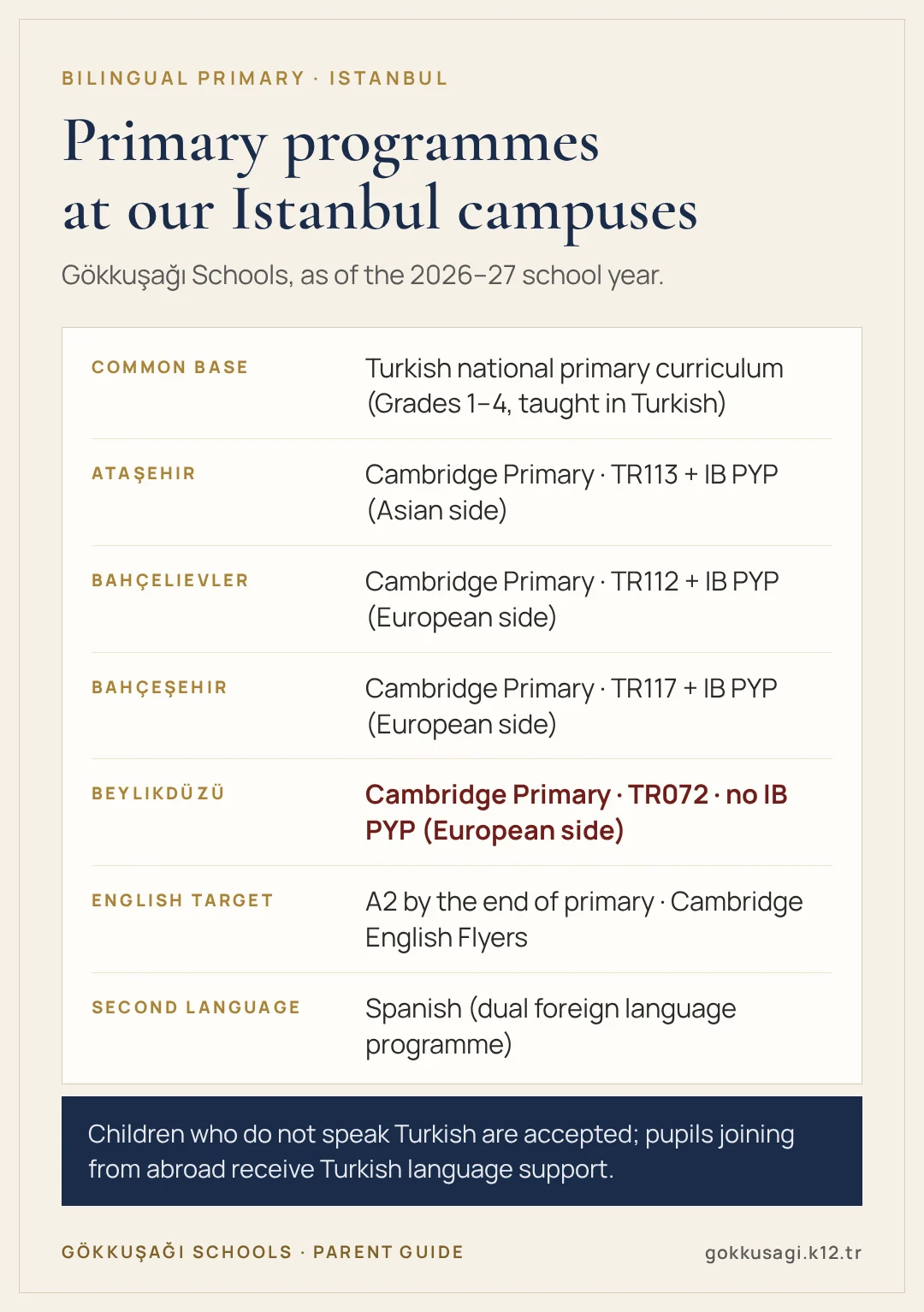
In Istanbul, the choice between campuses is often narrowed by the commute before the programme. Families living on the Asian side usually look at Ataşehir; families on the European side at Bahçelievler, Bahçeşehir and Beylikdüzü. Our guide on where to live in Istanbul with kids covers neighbourhoods and school runs, and the international school in Istanbul page shows all four campuses together.
How does English show up in a typical day at a Gökkuşağı primary school?
At Gökkuşağı, English is part of the programme from kindergarten onwards and continues in primary school through the Cambridge programme. In the school’s Cambridge programme, subjects such as science and mathematics are taught in English. By the end of primary school, the target is level A2 on the Common European Framework of Reference and the Cambridge English Flyers exam.
Cambridge English’s exams for young learners come in three steps: Pre A1 Starters, A1 Movers and A2 Flyers. They are designed for children aged 6 to 12, and results are not pass or fail: each skill is reported with up to five shields. For parents, this gives a clear, child-friendly picture of progress from year to year.
- A head start from kindergarten: in our kindergarten timetable, English takes 7 hours a week in the Junior group and 10 hours in the Senior group, so children arrive in Grade 1 already used to hearing and using English.
- A second foreign language: in our dual foreign language programme, the first foreign language is English and the second is Spanish. See dual foreign language education.
- Lessons in Turkish: as Ministry rules require, subjects such as Turkish and social studies are taught in Turkish, and children learn to read and write in Turkish in their first year of primary school.
- A multinational classroom: Gökkuşağı has students from 47 nationalities and teachers from 18.
- Looking ahead: by the end of middle school, the English target rises to B1–B2.
Parents often ask how many hours of English there are each week in primary school. Because the split changes with the grade and the programme, the most reliable answer is the weekly timetable for the grade your child will join, which you can ask for on a campus visit. Our guide to English-medium education in Turkey covers the wider picture.
Can a child who does not speak Turkish join a bilingual primary school?
Yes. Gökkuşağı Schools accepts children who do not speak Turkish and provides Turkish language support for pupils joining from abroad. Because English is a language of instruction from kindergarten onwards, a child can follow part of the lessons in English while their Turkish develops. Primary age is a good time to pick up a new language.
In the first months, children usually listen first and then start using everyday phrases. Regular contact between school and family, and keeping the home language strong, make the transition easier. We describe the stages in detail in Starting school in Turkey without speaking Turkish.
The real test of a bilingual primary school is not how many hours of English a child hears, but whether they can think and talk comfortably in both languages.
What should families ask when visiting a bilingual primary school?
The most useful questions on a visit to a bilingual primary school are those with answers you can check: the programme’s authorisation code, which subjects are taught in English, the real number of pupils in the class, how Turkish and home languages are supported, and the English level expected after four years.
- Is the school authorised for Cambridge Primary or the IB PYP? What is its centre code or IB directory entry?
- Which subjects are taught in English and which in Turkish? Can we see the weekly timetable?
- Who teaches English, and how many pupils are in the class?
- What English level is expected by the end of primary school, and how is it measured?
- How is a child who speaks little or no Turkish supported?
- How does the programme continue into middle school?
For a fuller checklist, see questions to ask when visiting a school in Turkey; for the wider criteria, our guide to choosing a private primary school.
In short
- “Bilingual primary school” is not a legal category in Turkey: Ministry-registered private primary schools teach in Turkish and use English intensively alongside the national curriculum.
- The international programmes most common in Istanbul’s English-rich primary schools are Cambridge Primary (typically ages 5–11) and the IB PYP (ages 3–12 in the IB’s definition).
- As of 2026–27, all four Gökkuşağı campuses in Istanbul teach Cambridge Primary; the IB PYP is offered at Ataşehir, Bahçelievler and Bahçeşehir, but not at Beylikdüzü.
- Our English target by the end of primary is A2 and Cambridge English Flyers; the second foreign language is Spanish.
- Children who do not speak Turkish are accepted and receive Turkish language support.
Visit our Istanbul campuses
The details of our primary school programme are on its own page. You can book a campus tour online from each campus page or fill in the information request form and our admissions team will call you in English, Russian or Turkish.
Frequently Asked Questions
What is a bilingual primary school in Istanbul?
It is usually a private primary school under the Turkish Ministry of National Education that follows the national curriculum in Turkish and uses English intensively, often through an international programme such as Cambridge Primary or the IB PYP. “Bilingual” is not a legal school type; the language of instruction in Turkish schools is Turkish.
Can primary lessons in Turkey be taught in English?
Ministry rules make Turkish the language of instruction, and subjects such as Turkish, social studies, history, geography and religious culture may not be taught in a foreign language. Schools use English within this framework: in English lessons and in the lessons of an international programme. In Gökkuşağı’s Cambridge programme, subjects such as science and mathematics are taught in English.
Is there a Cambridge primary school in Istanbul?
Yes. All four Gökkuşağı Schools campuses in Istanbul are authorised Cambridge International Schools that teach Cambridge Primary: Ataşehir (TR113), Bahçelievler (TR112), Bahçeşehir (TR117) and Beylikdüzü (TR072). Other schools’ status can be checked in Cambridge’s “Find a Cambridge school” directory.
Which Gökkuşağı campuses in Istanbul offer the IB PYP?
As of the 2026–27 school year, the IB PYP is authorised at the Ataşehir, Bahçelievler and Bahçeşehir campuses. The Beylikdüzü campus does not offer IB programmes; it is a Cambridge International School with centre code TR072.
What age is Cambridge Primary for?
According to Cambridge International Education, Cambridge Primary is typically for children aged 5 to 11. In Turkey, primary school covers Grades 1–4, so schools run the programme alongside the national curriculum, followed by Cambridge Lower Secondary in middle school.
What English level do children reach by the end of primary school?
At Gökkuşağı, the target by the end of primary school is level A2 on the Common European Framework of Reference and the Cambridge English Flyers exam. By the end of middle school, the target is B1–B2.
Can my child join a Turkish private primary school in Istanbul without speaking Turkish?
Yes. Gökkuşağı Schools accepts children who do not speak Turkish and provides Turkish language support for pupils joining from abroad. As English is a language of instruction from kindergarten onwards, children can follow part of their lessons in English while their Turkish develops.
Will my child’s home language suffer at a bilingual school?
It should not. The IB asks PYP schools to support pupils’ mother tongues as well as the host-country language, and keeping the home language strong at home gives the new languages a firmer base. It is worth asking each school how it supports home languages in practice.