Starting School in Turkey Without Speaking Turkish: How Children Adapt
Can a child start school in Turkey without speaking Turkish? Enrolment, MEB adaptation classes, Turkish support in private schools, the stages of the first year and how to keep the home language strong.
Yes, a child can start school in Turkey without speaking Turkish: the language is generally not a condition of enrolment, and children learn it at school. The first months are the hardest, and how quickly a child adapts depends on their age, the type of school and the support they get from school and family. This guide covers how the first year usually goes, what to ask a school and how to keep the home language strong, as of the 2026-2027 school year.
Can a child enrol in a Turkish school without speaking Turkish?
Generally, yes. International children enrol in Turkish state and private schools on the basis of their documents and age, not a Turkish language test. A private school may hold its own meeting or level assessment, but its purpose is to find the right class and support, not to turn away a child who does not yet speak Turkish.
Official enrolment requires a passport, a residence permit and a foreigner identification number, and previous years of schooling abroad are recognised through denklik (equivalency). The steps are explained in our guide to enrolling your child in a school in Turkey. If you are still weighing a Turkish school against an international or Russian-curriculum school, our comparison of schools in Turkey for Russian-speaking families sets out all three.
Where to apply for denklik, which documents are needed and whether a child can start school while waiting are explained step by step in our guide to school equivalency (denklik) in Turkey.
What Turkish support do state schools offer?
Turkey’s Ministry of National Education (MEB) opens adaptation classes (uyum sınıfı) for international pupils whose Turkish is not yet sufficient. Under MEB Circular 2025/62 of 14 August 2025, these classes ran in 29 provinces in the 2025-2026 school year, including Istanbul and Antalya, for Grade 2 pupils and, that year only, Grade 3 pupils as well.
Teaching in an adaptation class lasts two consecutive terms, after which the pupil continues in a regular class. Pupils are placed by a school commission. Where no adaptation class is available, pupils with insufficient Turkish are referred to Turkish courses at public education centres (halk eğitim merkezi).
The provinces, grades and rules are set by circular and can change from year to year. What applies in 2026-2027 to your district, and to older children, is best confirmed with the provincial or district directorate of national education.
How do private schools support children who do not speak Turkish?
There is no single standard for private schools: each school decides how to support children who arrive without Turkish. That is why specific questions before enrolling are so useful: is there Turkish as a foreign language, which subjects are taught in English, who follows the child’s adaptation, and in which language does the school talk to parents?
- Are there separate Turkish lessons for beginners?
- Which lessons are taught in English, and which only in Turkish?
- How is a child assessed in the first months, before they fully understand the tasks?
- Who is responsible for settling in: the class teacher, the school counsellor, someone else?
- How many children in the class do not have Turkish as a first language?
- In which language does the school communicate with parents?
At Gökkuşağı, students joining from abroad receive Turkish language support so they can follow the academic programme while they learn. English is a language of instruction from kindergarten onwards, and in the Cambridge programme subjects such as science and maths are taught in English. As of the 2026-2027 school year, students from 47 nationalities study at the school. How much of the teaching is in English is covered in our guide to English-medium education in Turkey.
How does the first year usually go?
Adapting usually happens in stages: first the child listens and observes, then everyday phrases appear, then relaxed conversation with classmates, and only after that confident classroom language. The Canadian researcher Jim Cummins showed that conversational and academic language develop at different speeds, which helps parents read their child’s progress correctly.
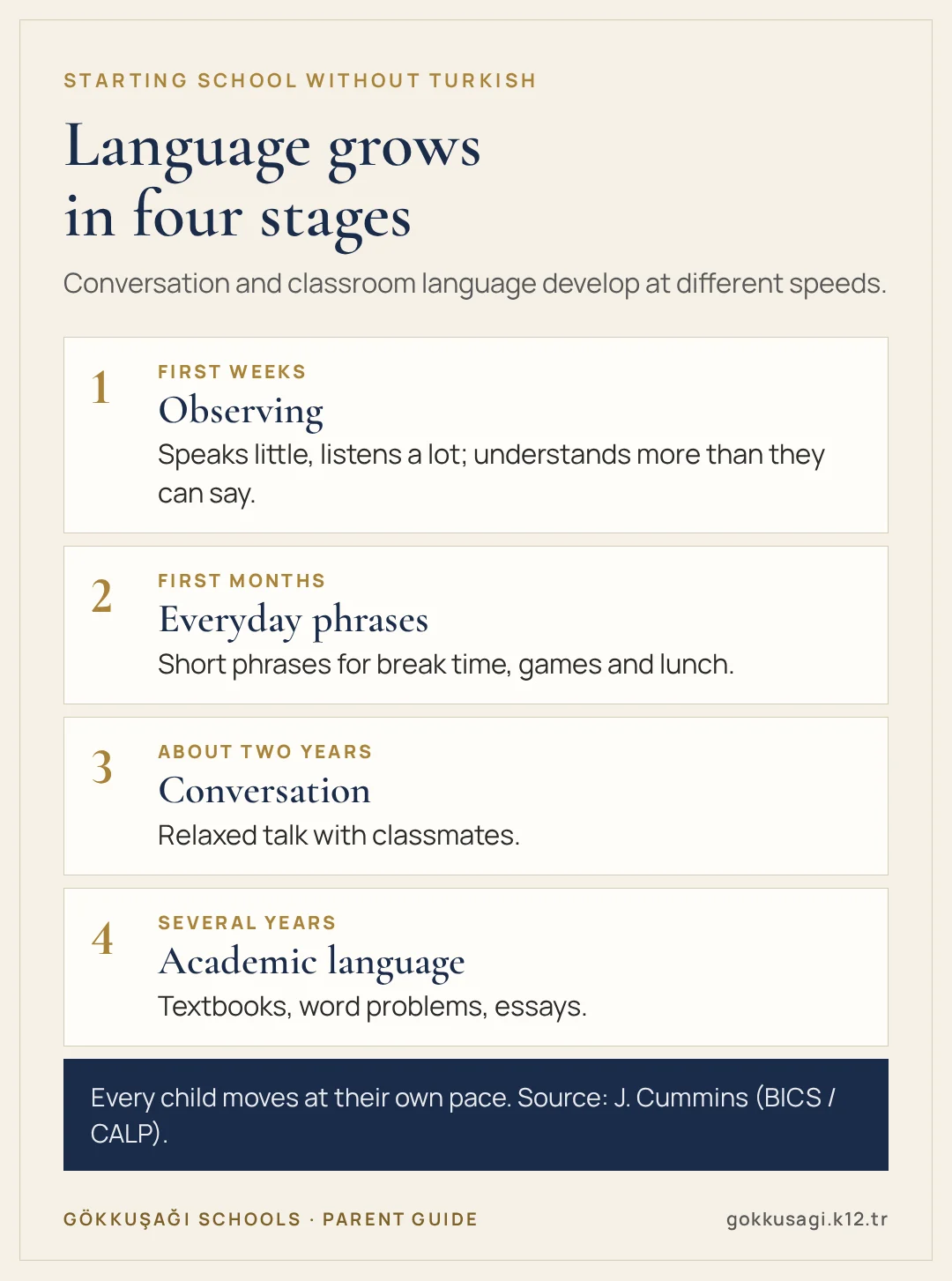
- Observing: in the first weeks many children hardly speak the new language. This is normal: the child is getting used to the sound of the language, the routine and classmates, and understands more than they can say.
- Everyday phrases: short phrases for break time, lunch and games arrive next: “Can I?”, “Let’s play together”, “I don’t understand”.
- Conversational language: according to Cummins, children learning a second language usually reach peer-level conversational fluency in about two years.
- Academic language: reading a textbook, understanding a word problem and writing an essay take longer; Cummins and colleagues speak of several years (typically 5-7), depending heavily on the child’s age and on how well they read and write in their first language.
Which subjects are easier and which are harder?
Subjects where language is not the main tool are usually easier: calculation in maths, PE, art, music and, if the child knows English, lessons taught in English. Turkish language and literature, subjects about life and history in Turkey such as Hayat Bilgisi (life studies) and Sosyal Bilgiler (social studies), and long word problems are harder.
Strong subjects give the child something to hold on to: success in maths or at sports practice protects confidence during the weeks when the language is not yet there. It helps to agree with teachers how language-heavy subjects will be assessed in the first months.
What affects how quickly a child adapts?
Children adapt fastest when they spend a lot of time with classmates, read and write confidently in their first language and sense that their family is calm. Age, temperament, English, school support and friendships outside lessons all play a part.
- Age: younger children usually join in play and conversation more easily. Teenagers find it harder because the load of academic language grows quickly in middle and high school.
- First language: a child who reads and writes well in their first language transfers those skills to the new one. A strong home language supports Turkish rather than holding it back.
- English: in schools where some subjects are taught in English, it gives the child a foothold in the first months.
- Temperament and surroundings: sociable children speak sooner; cautious children stay quiet longer but often understand just as much. Clubs, sports and neighbourhood friends let the language be heard in a happy setting.
How can parents help at home?
Calm and routine matter most at home. Short daily conversations about school, a predictable day, play dates with classmates and interest in new words without any test pressure all help. There is no need to switch to Turkish at home: the home language remains the child’s anchor.
- Learning a few school phrases together before the first day: hello, “thank you”, “may I go out?”, “I don’t understand”.
- Asking about specific moments of the day rather than “How was school?”; our list of questions to ask your child after school can help.
- Turkish cartoons, songs and children’s books make the language part of free time, not only of lessons.
- Play dates after school build conversational language faster than any exercise.
- Enough sleep and a steady routine: working in a new language all day is very tiring.
How can a child keep their home language?
The home language survives when it stays the family’s living language: spoken at home, read aloud, used for films and with relatives. For reading and writing, many families add regular lessons in the home language, in person or online. Bilingualism does not slow down Turkish; reading and comprehension skills transfer from one language to the other.
When is it time to ask the school for help?
If, after several months, a child still does not want to go to school, complains that nobody talks to them, sleeps badly, often mentions aches with no clear cause or loses interest in things they used to love, a conversation with the class teacher and the school counsellor is a good step. Talking early helps find a solution sooner.
At Gökkuşağı, the guidance and psychological counselling team works with students from kindergarten to high school. On the English and Russian forms, parents can choose the language of the follow-up call: English, Russian or Turkish.
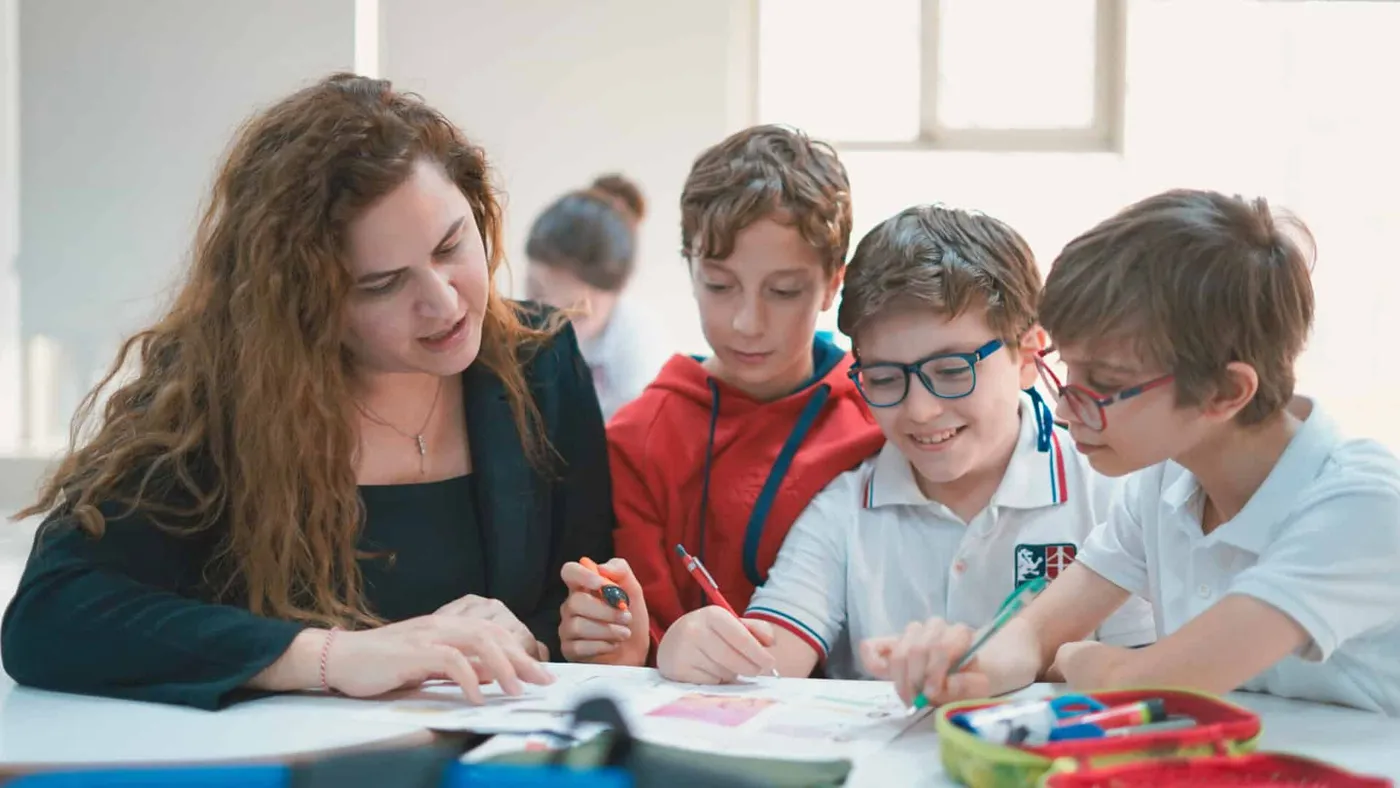
Easy chatter at break time comes before confident language in lessons. That is a normal path, not falling behind.
In short
- A child can start school in Turkey without speaking Turkish; the language is generally not a condition of enrolment.
- MEB opens adaptation classes (uyum sınıfı) in state schools; in 2025-2026 they ran in 29 provinces, including Istanbul and Antalya.
- Private schools have no single standard, so it pays to ask about Turkish support before enrolling.
- Conversational language takes about two years, academic language several years; every child moves at their own pace.
- Maths, sport, art and English-taught lessons come easier; Turkish and subjects about Turkey are harder.
- A strong home language supports Turkish, so it is worth keeping it alive at home.
- At Gökkuşağı, students joining from abroad receive Turkish language support.
Frequently Asked Questions
Can a child attend a Turkish school without speaking Turkish?
Yes. Speaking Turkish is generally not a condition of enrolment at a Turkish state or private school; children learn the language at school. The first months are harder, so it is important to find out in advance what Turkish support the chosen school provides.
How long does it take a child to speak Turkish?
First everyday phrases usually come within the first months. According to researcher Jim Cummins, children learning a second language typically reach peer-level conversation in about two years and confident academic language in several years. Timing depends on age, temperament and surroundings.
Do Turkish state schools have classes for international pupils?
Yes. MEB opens adaptation classes (uyum sınıfı) for international pupils whose Turkish is not yet sufficient. Under Circular 2025/62, in 2025-2026 they ran in 29 provinces, including Istanbul and Antalya, for Grades 2 and 3. The current year’s rules can be confirmed with the directorate of national education.
At what age is it easiest to start a Turkish school?
Younger children usually join in play and conversation more easily. Teenagers face a heavier load of academic language in middle and high school, so when moving at that age it helps to discuss workload and support with the school in advance.
Does my child need a Turkish tutor before we move?
Not necessarily. A few lessons can build confidence, especially for teenagers, but the main source of the language is real communication at school. Days in a new language are tiring enough, so it is wise not to overload the child in the first months.
How does Gökkuşağı support children who do not speak Turkish?
Students joining from abroad receive Turkish language support so they can follow the academic programme while they learn. English is a language of instruction from kindergarten onwards, and the school has students from 47 nationalities.
Will my child forget their home language?
The home language survives when it stays a living language: spoken at home, read and used with relatives. Many families add regular lessons in the home language. Bilingualism does not hold back Turkish; reading skills transfer from one language to the other.
Documents, denklik and level assessment are covered in our guide to enrolling your child in a school in Turkey. Families in Antalya may find our guide to an international school in Antalya useful, and families moving to Istanbul our guide to moving to Istanbul with children. To arrange a meeting, simply fill in the information request form.