School Open Day in Turkey: Questions to Ask When Visiting a School
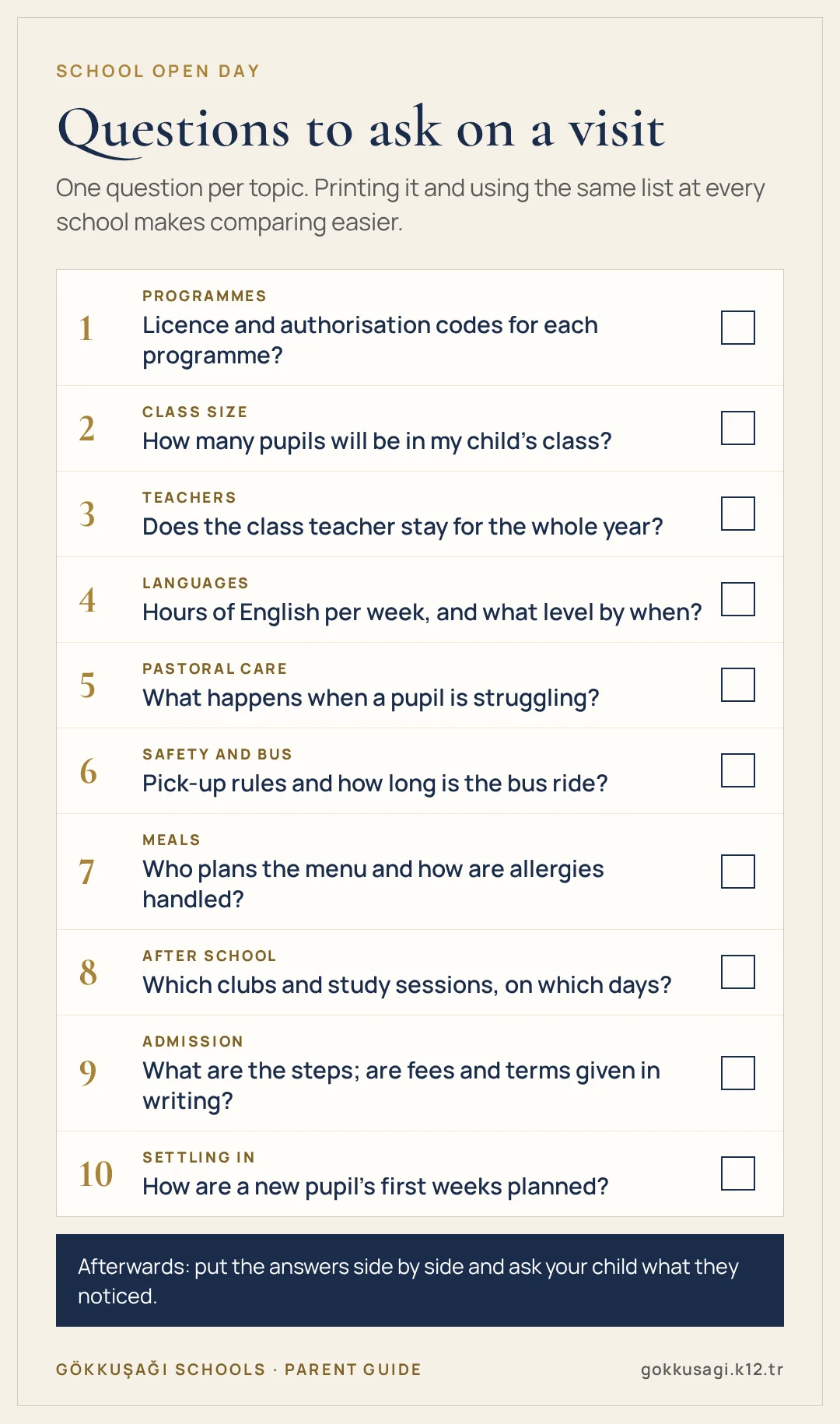
Questions to ask when visiting a school in Turkey, grouped by topic: licence and programmes, class size, teachers, English, pastoral care, safety, meals, after school, admission and settling in.
When visiting a school in Turkey, the most useful questions are the ones a brochure does not answer: whether the school and its international programmes are officially licensed and authorised, how many pupils will really be in your child’s class, who teaches English, how a child without Turkish is supported, and how safety, meals, admission and the first weeks are handled. This guide groups those questions into ten topics, explains why each one matters and ends with a printable checklist for families touring schools in Istanbul, Ankara, Izmir, Bursa or Antalya.
Information is current as of 26 November 2026. Regulatory details come from announcements of Turkey’s Ministry of National Education (MEB) and texts published in the Official Gazette.
What questions should you ask when visiting a school in Turkey?
The questions to ask on a school visit in Turkey fall into ten topics: licence and programmes, class size, teachers, languages, pastoral care, safety and school bus, meals, after-school time, admission and settling in. Choosing two or three questions per topic and asking the same ones at every school makes the answers comparable and the decision far more concrete.
Open days are the quickest way to get to know a school, but presentations tend to sound alike. The difference shows in the answers. We cover the wider criteria in what to consider when choosing a private school; this guide turns them into concrete questions for the day itself. For age-specific questions there are two more detailed guides: an English-speaking kindergarten in Istanbul checklist for ages 4–6, and a guide for families looking at a private high school in Beylikdüzü.
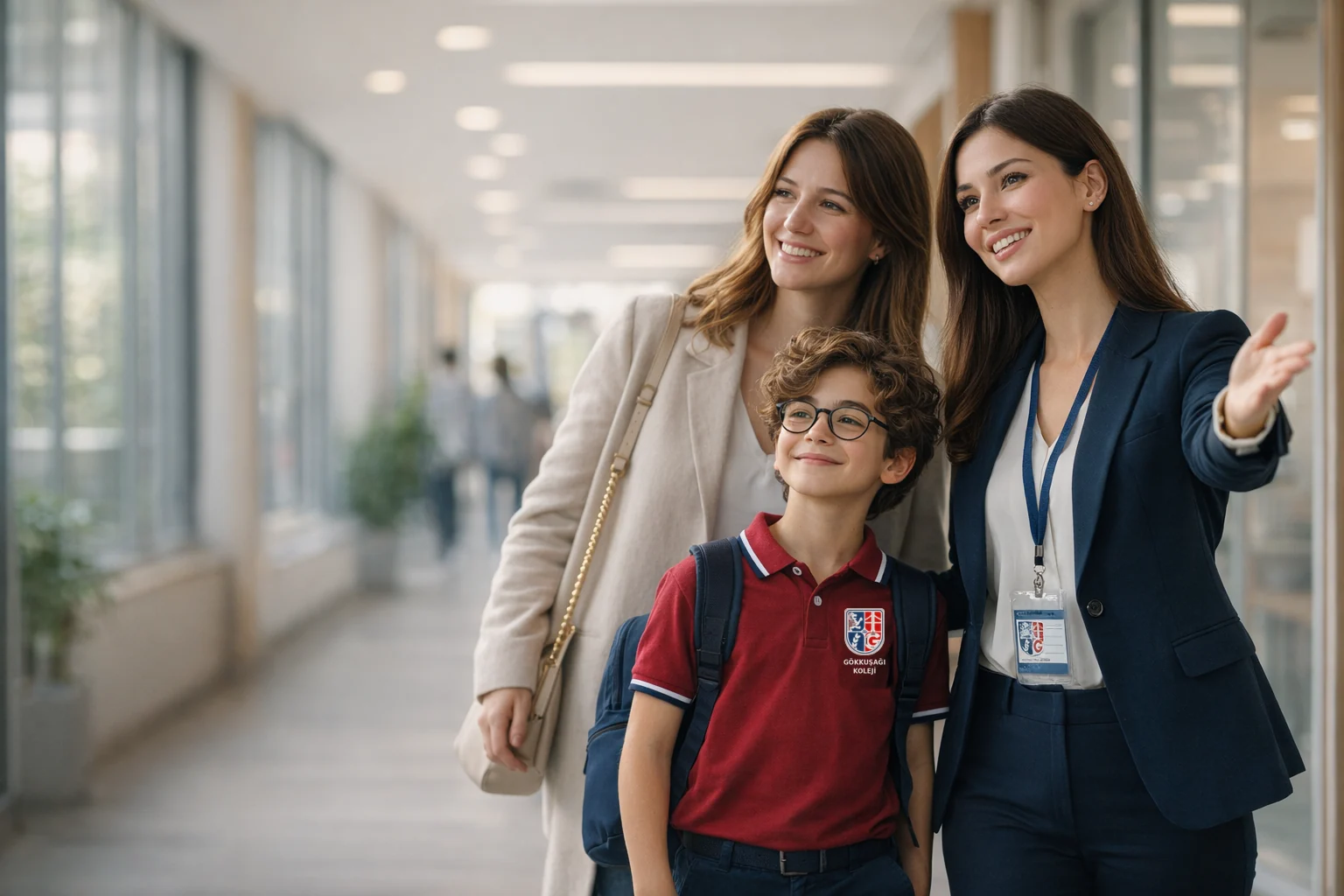
How should international families prepare for a school open day?
Before the visit, it helps to write down your child’s current grade and curriculum, your three non-negotiables, the commute from home and any specific need such as Turkish language support, a health condition or a learning difference. With that list, the short time on site goes to what matters most, and you can ask whether the visit or a follow-up call can be held in English.
An open day and a booked campus tour complement each other. On an open day you meet the team and hear about the programme; on a booked tour you can see lessons, corridors and break time on a normal school day. A second visit is also a good moment to return to questions left unanswered.
- Bring your child: how they react to the building and the people tells you as much as any answer.
- Bring school records: recent reports and the name of the previous curriculum help the school explain where your child would be placed.
- Ask for documents: the weekly timetable, the school calendar and the admission terms in writing complement what is said in person.
1. Licence and programmes: what should you verify?
Every private school in Turkey operates under a licence from the Ministry of National Education (MEB), and every international programme it names should be authorised by the body that owns it. So the first questions are about the MEB licence and the authorisation of the IB or Cambridge programmes, campus by campus and grade by grade.
In an announcement on 25 April 2026, MEB reminded parents that they can check whether an institution is ministry-approved with the QR code displayed at the school or on the website of its General Directorate of Private Education Institutions. International Baccalaureate (IB) authorisation can be checked in the IB’s “Find an IB World School” directory, and Cambridge schools in Cambridge International’s “Find a Cambridge school” search. Cambridge International also advises asking a provider for its Cambridge centre number and certificate.
- Where can we see the school’s MEB licence or QR code?
- Which international programmes are offered, and for which campus and grades is each one authorised?
- How do the Turkish national curriculum and the international programme fit together in the weekly timetable?
- Which international exams can pupils sit at the school?
Gökkuşağı Schools shows why the campus matters: all eight campuses are Cambridge International Schools, each with its own Cambridge code, while the IB Primary Years Programme runs only at Ataşehir, Bahçelievler and Bahçeşehir, and the IB Diploma Programme only at Bahçelievler and Ankara Çankaya. The Cambridge education page sets out the pathway.
2. Class size: how many pupils will be in my child’s class?
Class size decides how closely a teacher can follow each pupil. Rather than the school-wide average, it is worth asking how many pupils are in the class your child would join this year, whether that number can grow during the year and whether classes are split into smaller groups for languages, labs or options.
- How many pupils are in the class my child would join, and what is the maximum?
- Are classes split for English, science labs or electives?
- In kindergarten and primary, is there an assistant in the room as well as the teacher?
On the Gökkuşağı campus pages that list it, the average class size is roughly 15 to 20 pupils. Whichever school you visit, asking by campus and grade gives the most accurate answer.
3. Teachers: who teaches, and how long have they been there?
Teacher continuity shapes a child’s sense of security, especially in primary school. Whether the class teacher stays all year, how experienced the subject teachers are and what professional training the school provides say more about daily quality than any brochure. These questions can be asked politely and in general terms.
- Does the class teacher usually stay with the class for the whole year?
- How long, on average, have teachers worked at the school?
- Who teaches English, and are there international teachers?
- What training do teachers receive in the IB or Cambridge programmes?
Gökkuşağı Schools has teachers from 18 nationalities and students from 47. If you can watch a few minutes of a lesson, the way a teacher speaks to the class will tell you more than any answer.
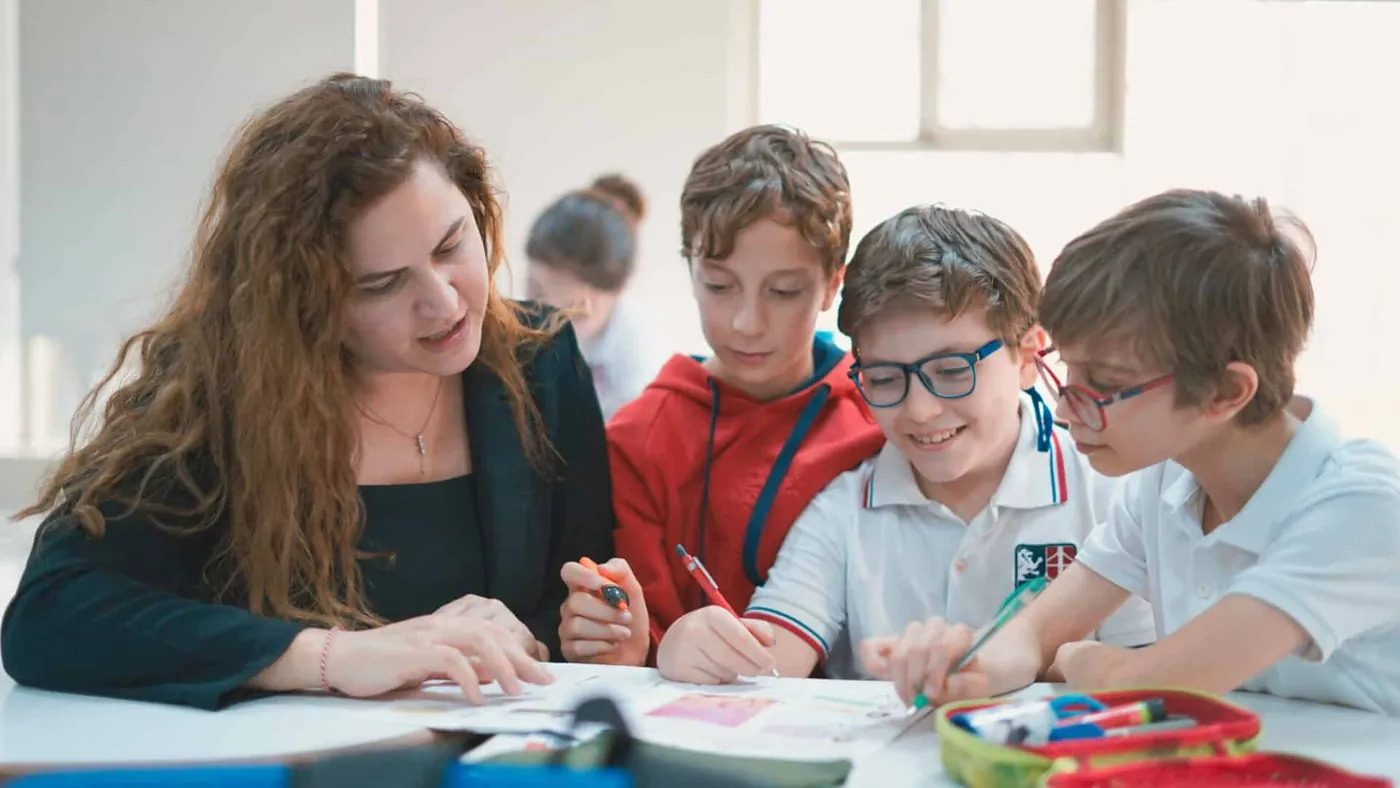
4. Languages: how much English, and what about Turkish?
For international families, language is often the deciding question. It helps to ask how many hours of English there are each week, which subjects are taught in English, what level is expected by the end of each stage and how it is measured. The second half of the question matters just as much: how a child who does not yet speak Turkish is supported in Turkish-medium lessons.
- How many hours of English per week in each stage, and which subjects are taught in English?
- Which CEFR level is expected at the end of each stage, and how is it assessed?
- Is there Turkish language support for pupils arriving from abroad, and in what form?
- When does a second foreign language start, and which languages are offered?
At Gökkuşağı Schools, English is a language of instruction from kindergarten onwards and Turkish language support is provided for students joining from abroad. In the dual foreign language programme, English is the first foreign language and Spanish the second; the end-of-middle-school targets are CEFR B1–B2 in English and A2 in Spanish.
5. Pastoral care: what happens when a pupil is struggling?
A guidance service shows its value when things do not go smoothly. Asking who notices a drop in grades, a friendship problem or anxiety, how parents are told and what steps follow reveals whether the school looks at the whole child. University and career guidance belong under the same heading for older pupils.
- How many school counsellors are there, and how many pupils does each one support?
- Who takes the first step when a pupil struggles, and when are parents informed?
- Is there a written anti-bullying policy?
- How are subject choices, exam preparation and university applications guided in secondary school?
At Gökkuşağı Schools, guidance and psychological counselling runs from kindergarten to high school; from Grade 9 each student builds a target university list, with support for international applications including portfolios, references and exam calendars.
6. Safety and school bus: how does my child get to and from school?
On safety, the key questions are how entry and exit are controlled and who a child may be handed over to. If you will use the school bus, it is worth asking about the route, the journey time and whether an escort travels on board. Turkey’s School Bus Regulation requires an escort alongside the driver, except on buses carrying high school or university students.
- How are visitors registered, and who is allowed to collect my child?
- Is there a nurse or medical room, and how are parents told about an accident or illness?
- How often are emergency and evacuation drills held?
- Is there a bus from our neighbourhood, how long is the ride, and is there an escort on board?
The regulation, published in the Official Gazette on 25 October 2017, also requires bus operators to keep to the maximum journey times set by MEB. Gökkuşağı Schools lists its bus service areas on each campus page, and campus advisors can confirm the route for a specific neighbourhood.
7. Meals: who plans the menu, and how are allergies handled?
In a full-day school, lunch is part of the education. Useful questions are whether meals are cooked on site, who plans the menu, how allergies and special diets are recorded and what snacks are offered. MEB states that in private schools the meal service should run through an agreement with the school management rather than separate deals between parents and third parties.
- Are meals prepared in the school kitchen, and who plans the menu?
- How are allergies, vegetarian diets or religious dietary needs managed?
- Are breakfast and snacks included in the day, and is the monthly menu shared with parents?
- Can we see the dining hall during the visit?
At Gökkuşağı Schools, meals are prepared daily in the campus kitchen, with menus planned under a dietitian’s supervision.
8. After school: what happens when lessons end?
School finishing times and working hours do not always match. Asking whether there are study sessions, clubs or sport after lessons, on which days and at what times, and how they connect to the bus timetable shows what your child’s day will actually look like.
- What time does the school day end, and is there supervised study afterwards?
- Which clubs, sports and arts are offered, and how many can a child join?
- Is there a later bus after clubs?
- Does the school run programmes at weekends or in the holidays?
At Gökkuşağı Schools, activities are grouped in the CAP programme: 43 branches across eight areas, from sport and arts to music, STEM and languages.
9. Admission and fees: what are the steps for an international student?
Knowing the admission steps, any entrance exam or interview, the documents required and the availability of places avoids last-minute stress. Fees and payment terms are best requested from the school in writing rather than taken from a conversation; only written terms allow a fair comparison between schools. International families should also ask which documents from abroad are needed.
- What are the admission steps; is there an exam, interview or placement assessment?
- Which documents are needed for a student arriving from abroad?
- Can the fees, payment terms and what the fee includes be provided in writing?
- If scholarships or discounts exist, are their conditions written down?
According to MEB’s announcement of 27 March 2025, private schools announce the fees for their services, these fees appear in the enrolment contract signed with the parent and payments go to a bank account opened in the school’s name. The paperwork for families moving to Turkey is covered in our school enrollment in Turkey guide, and the wider enrolment checklist in private school enrolment: what to check.
At Gökkuşağı Schools, admission starts with the information request form, where parents can choose the language of the follow-up call (Turkish, English or Russian), followed by a campus visit and an introductory meeting. International students do not sit the scholarship exam; the campus arranges an individual entrance exam for them.
10. Settling in: how are a new pupil’s first weeks planned?
Starting a new school is a transition at any age, and more so in a new country and language. Asking whether there is an induction plan, who looks after a new pupil in the first weeks and how often parents hear from the school shows whether settling in is planned or left to chance.
- Is there an induction programme for new pupils, and what happens in the first week?
- How is a pupil who joins mid-year welcomed and helped to catch up?
- Is a buddy or a named adult assigned to a pupil who does not speak Turkish?
- How are transitions between stages (kindergarten to primary, middle to high school) prepared?
How children without Turkish adapt, step by step, is explained in starting school in Turkey without speaking Turkish.
The most valuable moment of an open day is not when a school says “we have everything”, but when it explains “this is what we do when…”.
Which extra questions matter at each stage?
The ten topics apply at every stage, but the weight shifts with age. Play, settling in and self-care lead in kindergarten; reading, writing and the class teacher in primary; more subjects and exam preparation in middle school; and university routes and international qualifications in high school.
| Stage | Extra questions worth asking |
|---|---|
| Kindergarten (ages 4–6 at Gökkuşağı) | How much of the day is play? Can settling in be extended if needed? Is rest time planned by age? |
| Primary (Grades 1–4) | How are reading and writing taught, in Turkish and in English? What is the homework policy? Does the class teacher stay for all four years? |
| Middle school (Grades 5–8) | How is the move to subject teachers supported? Is exam preparation part of the timetable? How much time is left for activities? |
| High school (Grades 9–12) | Which international diplomas or exams are available, and at which campus? How are university applications in Turkey and abroad supported? |
At Gökkuşağı Schools, kindergarten is for children aged 4–6 (there is no age-3 group); primary covers Grades 1–4, middle school Grades 5–8 and high school Grades 9–12.
How do you compare schools after the visits?
After the visits, putting the answers to the same questions side by side turns impressions into something you can weigh. Clear answers backed by documents, and topics the school raised without being asked, are strengths; vague answers are worth a follow-up email asking for written information. Your child’s impressions are part of the decision too.
The broader criteria are covered in what to consider when choosing a private school. Families who would like to visit a Gökkuşağı campus or arrange an admission meeting can get in touch through the information request form.
In short
- Questions for a school visit in Turkey fall into ten topics: licence and programmes, class size, teachers, languages, pastoral care, safety and bus, meals, after school, admission and settling in.
- An MEB licence can be checked with the school’s QR code or on the ministry’s private education website; IB and Cambridge status in the official IB and Cambridge directories.
- The real size of your child’s class matters more than the school average, as does whether the class teacher stays all year.
- For international families, the key language questions are how much English there is and how Turkish is supported.
- Fees and payment terms can be requested in writing; under MEB rules, fees are announced and written into the enrolment contract.
- Using the same list at every school and asking your child what they noticed makes the decision concrete.
Frequently Asked Questions
What questions should I ask when visiting a school in Turkey?
The questions can be grouped into ten topics: licence and programmes, class size, teachers, languages, pastoral care, safety and school bus, meals, after-school time, admission and settling in. Choosing two or three questions per topic and asking the same ones at every school makes the answers easy to compare.
How can I check that a private school in Turkey is licensed?
According to a Ministry of National Education (MEB) announcement of 25 April 2026, parents can check whether an institution is ministry-approved by scanning the QR code displayed at the school or on the website of MEB’s General Directorate of Private Education Institutions. The QR code shows the institution’s name, field of activity and founder.
How do I know if a school is really an IB or Cambridge school?
IB authorisation can be checked in the IB’s official “Find an IB World School” directory and Cambridge schools in Cambridge International’s “Find a Cambridge school” search. It is also worth asking which campus and grades the authorisation covers: at Gökkuşağı Schools, all eight campuses are Cambridge schools, while the IB runs at four.
Can my child join a school in Turkey without speaking Turkish?
Whether a school accepts pupils without Turkish, and how it supports them in lessons, is worth asking directly. At Gökkuşağı Schools, English is a language of instruction from kindergarten onwards and Turkish language support is provided for students joining from abroad.
Is it acceptable to ask about fees on an open day?
Yes. You can ask for the fees, payment terms and what the fee includes in writing. Under MEB’s announcement of 27 March 2025, private schools announce the fees for their services, and these fees appear in the enrolment contract.
Do international students take an entrance exam at Gökkuşağı?
International students do not sit the Gökkuşağı scholarship exam; the campus arranges an individual entrance exam for them. Admission starts with the information request form, followed by a campus visit and an introductory meeting.
Should I bring my child to a school open day?
In most cases it helps: the way a child reacts to the school says as much as the answers you hear. Involving teenagers in the decision also makes settling into a new school easier.