Do International Schools in Turkey Teach Turkish? The Rules by School Type
Do international schools in Turkey have to teach Turkish? What the law says for international (milletlerarası), foreign and Turkish private schools, who can enrol in each, and what it means for diplomas.
Yes. Since 1 September 2025, international (milletlerarası) schools in Turkey that follow a foreign curriculum must also teach Turkish and lessons on Turkish history, according to a weekly timetable approved by the Ministry of National Education (MEB). In Turkish private schools that follow the national curriculum, Turkish is simply part of every pupil’s timetable. The school type also decides who may enrol: only foreign nationals can attend an international school.
This guide compares the three types of school in Turkey, as of the 2026–2027 school year, from one angle only: the Turkish language and the curriculum. It is based on the Private Education Institutions Law No. 5580 and the MEB Private Education Institutions Regulation. For an example of a school where Turkish and international pupils learn together, following the Turkish curriculum with Cambridge and the IB, see our international school in Istanbul. For the wider comparison of school types, read our guide to choosing an international school in Turkey.
Do international schools in Turkey have to teach Turkish?
Yes. An amendment to the MEB Private Education Institutions Regulation, published on 3 January 2025, states that international schools running a programme other than the Turkish one must also teach Turkish and lessons on Turkish history, following a weekly timetable approved by the Ministry. A transitional clause brought the rule into force on 1 September 2025, so it applies throughout the 2026–2027 school year.
The rule does not turn an international school into a Turkish one. The school keeps its foreign programme, whether that is the IB, an English curriculum or another country’s programme. What changes is that Turkish and Turkish history lessons now appear in the weekly timetable. The regulation does not fix a number of hours; each school’s approved timetable sets them. The same amendment also made the curricula of international schools subject to approval by the Ministry’s Board of Education (Talim ve Terbiye Kurulu).
What is the difference between an international school, a foreign school and a Turkish private school?
Law No. 5580 defines three separate types. International (milletlerarası) private schools may be attended only by foreign nationals. Foreign (yabancı) schools are private schools originally founded by foreigners. Turkish private schools follow the Turkish curriculum, and some of them add international programmes such as Cambridge or the IB. The place of Turkish in the timetable depends on the type.
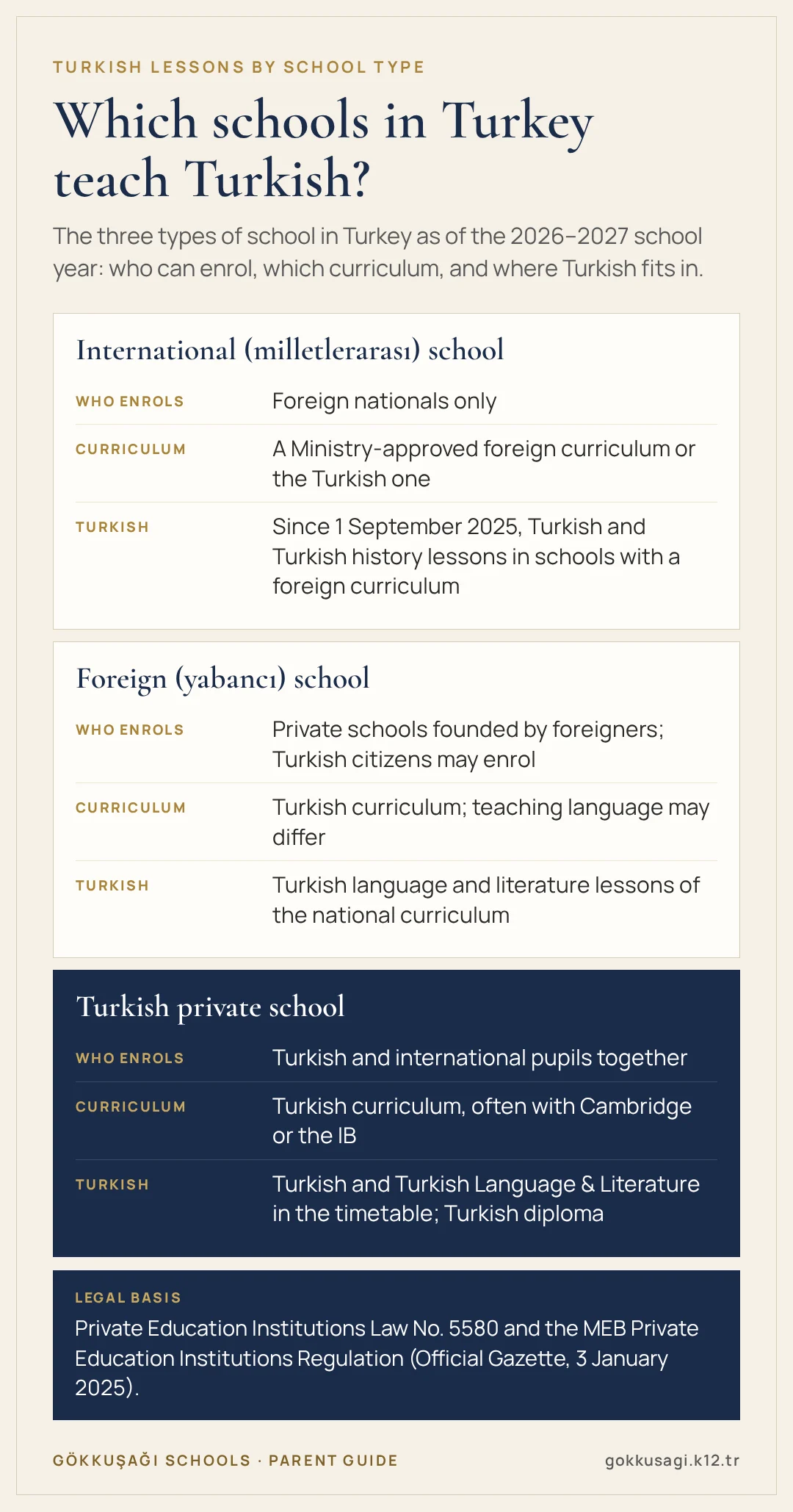
| School type | Who can enrol? | Curriculum | Turkish lessons | Leaving document |
|---|---|---|---|---|
| International (milletlerarası) school | Foreign nationals only | A Ministry-approved foreign curriculum, or the Turkish one | Turkish and Turkish history lessons in schools with a foreign curriculum (since 1 September 2025) | The document of the programme followed |
| Foreign (yabancı) school | Turkish citizens may enrol too | Turkish curriculum; the language of teaching may be another language | Turkish language and literature lessons of the national curriculum | Turkish diploma |
| Turkish private school | Turkish and international pupils together | Turkish curriculum, often with Cambridge or the IB | Turkish in primary and middle school; Turkish Language and Literature in high school | Turkish diploma, plus certificates of the international programme |
Article 6 of the Law says that the curriculum and weekly timetable of private schools are set within the rules applied to state schools, and that the Ministry may approve different programmes. International schools are covered by a separate clause: their programmes follow principles drawn up by the school and approved by the Ministry. Minority schools, protected by the Treaty of Lausanne, are a fourth type, but only Turkish-citizen children of the respective minority can attend them, so they are not an option for international families.
Which subjects do international schools in Turkey have to add?
The regulation names two areas: Turkish and lessons relating to Turkish history. They are taught according to a weekly timetable approved by the Ministry, alongside the school’s own foreign programme. The regulation applies to international schools that run a programme other than the Turkish one; an international school that runs the Turkish programme already teaches these subjects as part of it.
The text does not set a common number of hours or a single syllabus for every school, so the practical details vary. When comparing international schools, families can ask to see the approved weekly timetable for their child’s year group. It shows how many hours of Turkish and Turkish history are planned and where they sit in the week.
Can a child with Turkish citizenship attend an international school in Turkey?
As a general rule, no. Law No. 5580 defines international schools as institutions “that only foreign national students may attend”. The single exception is a pupil who gains Turkish citizenship while already enrolled: they may stay until the end of their current school stage, at the same school or at another international school running the same programme.
A provision added to the Law in July 2026 made this limit stricter. An international school that enrols Turkish-citizen pupils, or keeps them beyond the permitted period, faces an administrative fine and the cancellation of its operating permit. If any child in the family holds Turkish citizenship, including through dual nationality, the safest step is to confirm the school type and the child’s status with the provincial directorate of national education (il millî eğitim müdürlüğü) before enrolling.
The rule can split siblings. When one child is a Turkish citizen and the family wants all its children at the same school, a Turkish private school offering an international programme is often the practical choice, because Turkish and international pupils share the same classrooms there.
How is Turkish taught at foreign (yabancı) schools?
Foreign schools are private schools founded by foreigners but subject to the general provisions of the Law; their curriculum follows the rules applied to state schools. Article 8 requires schools that teach in a language other than Turkish to appoint a Turkish-citizen deputy head who is qualified to teach Turkish or Turkish culture subjects.
In practice, the language of teaching at a foreign school may not be Turkish, but the programme is the Turkish one and includes the Turkish language and literature lessons of the national curriculum. For a child who is new to Turkish, that can mean following lessons in a foreign language and in Turkish at the same time.
Do international pupils take Turkish lessons at Turkish private schools?
Yes. At a private school that follows the Turkish curriculum, an international pupil studies according to the same weekly timetable as the rest of the class, and Turkish (primary and middle school) or Turkish Language and Literature (high school) is part of it. Schools usually add language support for pupils who are new to Turkish; the form of that support varies from school to school.
Not speaking Turkish is not a barrier to enrolment: children are placed by age and documents, and their Turkish develops over time. How the first months usually go, and what helps at home, is covered in our guide to starting school in Turkey without speaking Turkish. If a question arises about an exemption or a different assessment in a particular subject (exemptions from Religious Culture and Ethics, for example, are governed by separate rules), the school can confirm the rule that applies to your family with the provincial directorate of national education.
A school’s legal type is more than a label: it decides which lessons a child takes, which diploma they receive and whether siblings can study under the same roof.
Can foreign children attend Turkish state schools, and is there Turkish support?
Yes. Foreign national children can enrol in Turkish state schools, where they follow the Turkish curriculum and are taught in Turkish. In some provinces and grades the Ministry opens adaptation classes focused on learning Turkish; where they run is decided each year by circular. The provincial or district directorate of national education can confirm what applies in your area.
For the overall framework of school stages, starting ages and the school year, see our guide to the Turkish school system.
How does the school type affect report cards, diplomas and later moves?
At a school following the Turkish curriculum, pupils receive Turkish report cards and, on graduation, a Turkish diploma, with any Cambridge or IB documents added on top. At an international school with a foreign curriculum, pupils receive that programme’s documents. If such a pupil later moves to a Turkish school, an equivalence (denklik) procedure is needed, just as for documents from abroad.
So the choice of school type depends on how long the family expects to stay and on university plans. If the family will stay in Turkey for years, or Turkish universities are an option, a school awarding the Turkish diploma makes later transitions simpler. If another international move is likely, continuity of an international programme matters more. A Turkish school that adds an international programme aims to meet both needs. The equivalence steps are explained in our guide to school equivalency (denklik) in Turkey, and the difference between an English curriculum and Cambridge in our guide to British curriculum schools in Turkey.
How do Turkish and international programmes work together at Gökkuşağı Schools?
Gökkuşağı Schools (Gökkuşağı Koleji) is a Turkish private school under the Ministry of National Education; it is not an international (milletlerarası) school. Turkish and international pupils learn in the same classes, and the Turkish lessons of the national curriculum are part of everyone’s timetable. All eight campuses are Cambridge International Schools, and IB programmes are authorised at four of them. Students graduate with the Turkish high-school diploma.
- Pupils: students from 47 nationalities. Children who do not speak Turkish are accepted, and pupils joining from abroad receive Turkish language support.
- Languages: English is a language of instruction from kindergarten onwards; the second foreign language is Spanish.
- Cambridge: centre codes Bahçelievler TR112, Ataşehir TR113, Bahçeşehir TR117, Beylikdüzü TR072, Ankara Çankaya TR962, Izmir Çiğli TR213, Antalya Muratpaşa TR450 and Bursa Özlüce TR963 (Cambridge education).
- IB: the Primary Years Programme (PYP) at the Istanbul Ataşehir, Bahçelievler and Bahçeşehir campuses; the IB Diploma Programme at the Istanbul Bahçelievler and Ankara Çankaya campuses in Grades 11–12. The IB Diploma is earned in addition to the Turkish diploma, not instead of it.
- Admission: international students do not take the scholarship exam; the campus arranges an individual entrance assessment.
What should families ask a school about Turkish lessons?
A few questions that pin down the school’s legal type and the place of Turkish in its programme make it easier to compare schools on the same terms. Each answer can be checked against an official record or the weekly timetable.
- What is the school’s legal type: international (milletlerarası), foreign (yabancı) or Turkish private school?
- How many hours of Turkish are in the weekly timetable for my child’s year group?
- How is extra Turkish support given to pupils who are new to the language, and for how long?
- Which diploma do graduates receive, and are international programme certificates added to it?
- If one of our children holds Turkish citizenship, can all our children enrol at the same school?
Families who would like to see a school where Turkish and international pupils learn together can start with our international school in Istanbul page or the information request form. Enrolment steps for international families are set out in our school enrolment guide for expats, and families who speak Russian at home may also find our guide to schools in Turkey for Russian-speaking families useful.
In short
- Since 1 September 2025, international schools in Turkey with a foreign curriculum must teach Turkish and lessons on Turkish history (MEB Private Education Institutions Regulation, amended 3 January 2025).
- Only foreign nationals may attend international (milletlerarası) schools; a pupil who becomes a Turkish citizen while enrolled may stay until the end of their stage.
- Foreign (yabancı) schools and Turkish private schools follow the Turkish curriculum, with Turkish language and literature built in.
- International pupils at Turkish private schools take Turkish lessons with their class; not speaking Turkish is not a barrier to enrolment.
- The school type decides the diploma: a Turkish school awards the Turkish diploma, an international school the documents of its programme.
- Gökkuşağı Schools is a Turkish private school that combines the Turkish curriculum with Cambridge at all eight campuses and the IB at four.
Frequently Asked Questions
Do international schools in Turkey have to teach Turkish?
Yes. Since 1 September 2025, international schools that run a programme other than the Turkish one must teach Turkish and lessons on Turkish history, following a weekly timetable approved by the Ministry of National Education. The rule comes from an amendment to the MEB Private Education Institutions Regulation published on 3 January 2025.
How many hours of Turkish do international schools in Turkey teach?
The regulation does not fix a common number of hours. Each international school teaches Turkish and Turkish history according to its own weekly timetable approved by the Ministry, so families can ask the school to show the timetable for their child’s year group.
Can Turkish citizens attend international schools in Turkey?
As a general rule, no. Under Law No. 5580, only foreign nationals may attend international (milletlerarası) schools. A pupil who becomes a Turkish citizen while enrolled may continue until the end of their school stage. Families with dual nationality are advised to confirm their case with the provincial directorate of national education.
Are international pupils exempt from Turkish lessons at Turkish private schools?
At a school following the Turkish curriculum, international pupils study according to their class’s weekly timetable, which includes Turkish. If a family has a question about an exemption or a different assessment in a specific subject, the school can confirm the applicable rule with the provincial directorate of national education.
Is a foreign (yabancı) school the same as an international school in Turkey?
No. An international (milletlerarası) school accepts only foreign nationals and may run an approved foreign curriculum. A foreign school is a private school founded by foreigners that follows the Turkish curriculum, and Turkish citizens may enrol there.
Is Gökkuşağı Schools an international (milletlerarası) school?
No. Gökkuşağı Schools is a Turkish private school under the Ministry of National Education. Turkish and international pupils learn together and graduate with the Turkish high-school diploma. All eight campuses are Cambridge International Schools, and IB programmes are authorised at four campuses.
Does Gökkuşağı support children who do not speak Turkish?
Yes. Children who do not speak Turkish are accepted, and pupils joining from abroad receive Turkish language support. English is a language of instruction from kindergarten onwards. International students do not take the scholarship exam; the campus arranges an individual entrance assessment.