Schools in Turkey for Russian-Speaking Families: Russian, International or Turkish Private?
Which school suits a Russian-speaking child in Turkey? A comparison of Russian-curriculum schools, foreign-nationals-only international schools and Turkish private schools: language, diploma, Turkish and university routes.
For Russian-speaking families, schools in Turkey usually come down to three options: a school teaching the Russian curriculum in Russian, an international school open only to foreign nationals, or a Turkish private school supervised by the Ministry of National Education (MEB), often with international programmes on top. The right choice depends less on rankings than on where your child will study after school and how long your family plans to stay in Turkey. This guide reflects the situation as of November 2026.
What types of schools can Russian-speaking children attend in Turkey?
Russian-speaking families in Turkey usually choose between three types of school: schools and learning centres teaching the Russian curriculum in Russian; international private schools that, under Turkish law, only foreign nationals may attend (milletlerarası okul); and Turkish private schools supervised by MEB, where Turkish and international children learn together, often alongside Cambridge or IB programmes.
The three options differ in almost everything: curriculum, language of instruction, the certificate a child leaves with and the universities it leads to. Before looking at individual schools, it helps to answer three questions:
- Where will your child go to university? In Russia, in Turkey or in a third country.
- How long will the family stay in Turkey? A year or two, or longer.
- How much Turkish will your child need? For friends, daily life and further study.
If you live in Antalya or Istanbul, the last section explains how our school works: our private school in Antalya (Muratpaşa Campus) and our international school in Istanbul (four campuses).
Are there Russian-language schools in Turkey?
Yes. In regions with many Russian-speaking families, especially on the Mediterranean coast and in Istanbul, there are schools and learning centres teaching the Russian curriculum in Russian. Their legal status in Turkey varies, so before enrolling it is worth checking whether the school holds a permit from the Ministry of National Education (MEB) and who issues the Russian school-leaving certificate.
Formats vary: schools attached to Russian diplomatic missions, private schools following the Russian curriculum, and learning centres where children attend in person but take their assessments remotely through a partner school in Russia. Current information on schools attached to Russian missions is published by the Russian Embassy and Consulates General in Turkey. We deliberately do not name individual schools: conditions change, and official sources are the safer reference.
How to apply for denklik through e-Denklik, and which documents are needed, is explained step by step in our guide to school equivalency (denklik) in Turkey.
How do the three types of school compare?
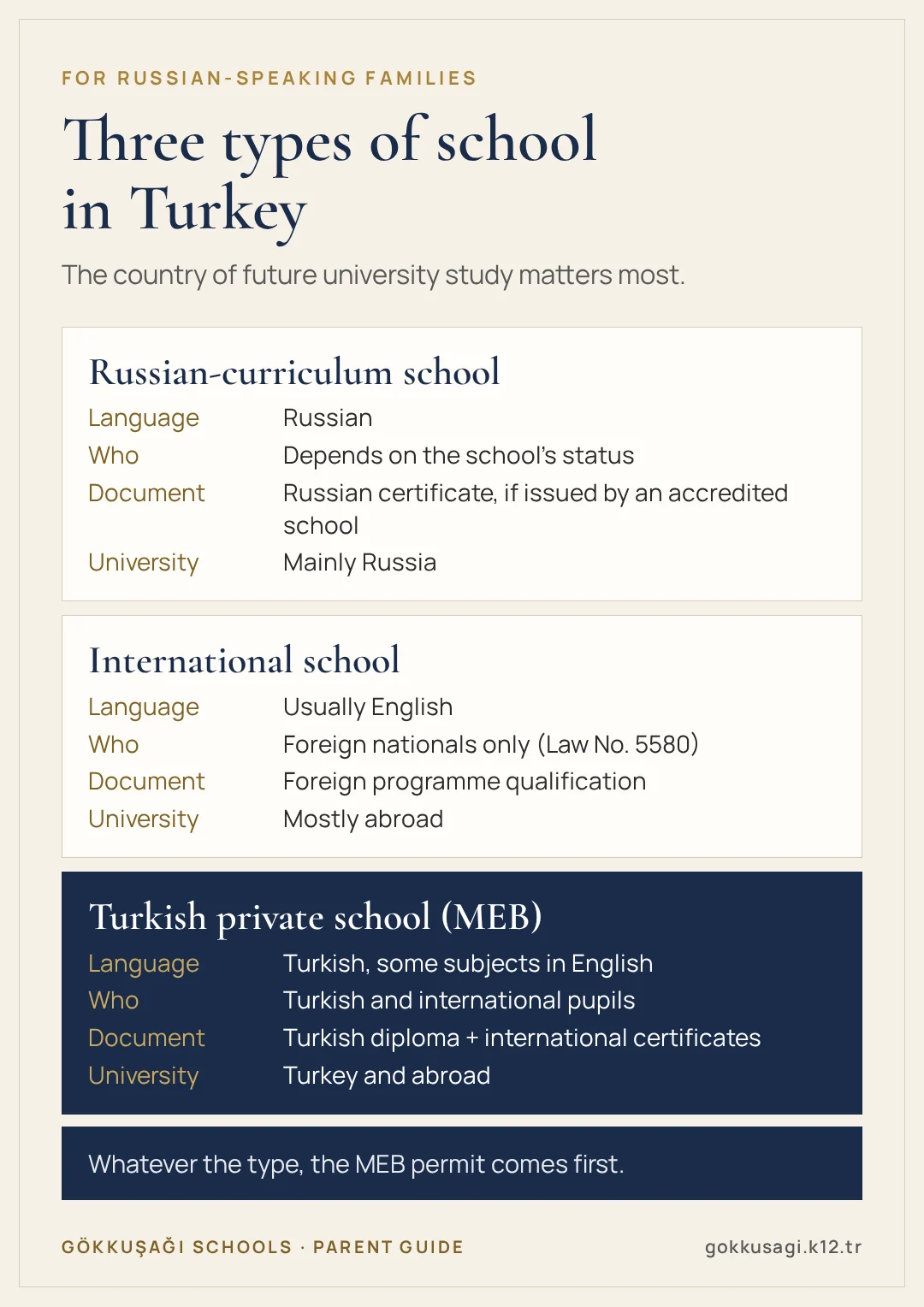
The key difference is the school-leaving document and where it leads. A Russian-curriculum school prepares for the Russian certificate and Russian universities. An international school for foreign nationals awards the qualification of its foreign programme. A Turkish private school awards the Turkish high school diploma and, where it runs international programmes, international certificates as well, keeping both Turkish and foreign universities open.
| Russian-curriculum school | International school for foreign nationals (milletlerarası okul) | Turkish private school (MEB) | |
|---|---|---|---|
| Curriculum | Russian | Foreign: British, American, IB and others | Turkish national curriculum, often with Cambridge or IB |
| Language of instruction | Russian | The programme’s language, usually English | Turkish; some subjects may be taught in English |
| Who can enrol | Depends on the school’s status | Foreign nationals only (Law No. 5580) | Turkish and international children together |
| Leaving document | Russian certificate, if issued by an accredited Russian school | The foreign programme’s qualification | Turkish diploma; international certificates at schools offering them |
| Turkish | As a subject, or hardly at all | Varies | Every day, in class and at break |
| University route | Mainly Russia | Mostly abroad | Turkey and abroad |
| What to check | MEB permit; who issues the certificate | MEB permit; recognition where your child will apply | Cambridge or IB authorisation codes; Turkish support |
The table gives the general picture; details depend on the school and on the family’s status. It is best to get written confirmation of which document your child will receive before enrolling.
When a Russian-curriculum school makes sense
It is a logical choice if the family plans to return to Russia within a year or two, or if an older child is preparing for the Russian state exams (OGE, EGE) and switching language of instruction would be too risky. The trade-off is slower progress in Turkish and a social circle that often stays Russian-speaking.
When an international school for foreign nationals makes sense
Families who move between countries often, or who are aiming for a university abroad from the start, tend to choose this route, especially if the child already studies in English. One important detail: under Law No. 5580 on Private Education Institutions, only foreign nationals may attend these schools. If your child holds Turkish citizenship, this is worth discussing with the school in advance.
When a Turkish private school makes sense
This route suits families staying in Turkey for longer, families who want to keep both Turkish and foreign universities open, and those who want their child to grow up among local peers rather than in a closed language bubble. The first months take more effort because of the language; after that, the child gains another working language.
How Turkish and Turkish history lessons are handled in each of these school types is covered in our guide on whether international schools in Turkey teach Turkish.
Can a child who does not speak Turkish attend a Turkish private school?
Yes. Speaking Turkish is generally not a condition of enrolment; children learn the language at school. Because the first months take extra effort, it is worth asking the school before enrolling how its Turkish support works and which lessons are taught in English. We describe the stages of settling in in our guide to starting school in Turkey without speaking Turkish.
Enrolment documents and recognition of previous schooling (denklik) are covered in our guide to enrolling your child in a school in Turkey.
Can a child combine a Russian online school with a Turkish school?
Many families do: the child attends a Turkish school and follows the Russian curriculum through family education (semeinoe obrazovanie), with assessments at a Russian school, often online. Russia’s Federal Law on Education (Articles 17 and 34) allows family education with the right to sit interim and final assessments at a school. The specific conditions are set by the Russian school you choose.
Before choosing this route, it helps to be realistic about the workload: two programmes mean two sets of expectations and two calendars. Families often focus the Russian programme on Russian language, literature and history, while maths and science are covered at the Turkish school. Planning assessment dates around the Turkish school year, which runs from September to June in two terms, makes life easier; MEB announces the exact dates each year.
On the Turkish side, enrolment in a Turkish school follows the usual rules. If a child studies only online and does not attend a Turkish school, the rules that apply to your situation are best confirmed with the Provincial Directorate of National Education.
How can you check a school before enrolling?
Three checks make a good start: whether the school holds an MEB permit, whether its international programmes appear in the official directories, and which document your child will receive at the end. A trustworthy school answers these questions in writing and without hesitation.
- MEB permit: confirmed with the Provincial Directorate of National Education.
- Cambridge: every authorised school has a Cambridge centre code, which can be checked in the Cambridge International Education school directory.
- IB: IB World School status is confirmed in the official school directory on ibo.org.
- Leaving document: which diploma or certificate your child will receive, and whether it is recognised where they plan to apply.
- Turkish support and parent communication: which language the school uses for announcements, parent-teacher meetings and admissions.
How does the university goal affect the choice?
A school-leaving document must be recognised where your child will apply. For Russian universities, foreign certificates usually go through a recognition procedure, with information provided by Glavekspertcentr, the national information centre under Rosobrnadzor (Article 107 of Russia’s Law on Education). Turkish universities have a separate admission route for international students. For third countries, international programmes carry the most weight.
It is wise to check the conditions for recognising a Turkish diploma in Russia while choosing a school, not in the final year. A pupil moving from a school abroad into a Turkish school has their previous studies recognised through denklik under MEB’s Equivalency Regulation (2024).
For families considering universities abroad, high school programmes matter. At Gökkuşağı, the IB Diploma Programme (Bahçelievler and Ankara Çankaya campuses) runs in Grades 11 and 12 and is earned in addition to the Turkish high school diploma, not instead of it; Cambridge Upper Secondary (IGCSE) exams are taken in high school at all campuses.
How do Russian-speaking children study at Gökkuşağı?
Gökkuşağı is a private school supervised by MEB, not a foreign-nationals-only school: Turkish and international children study together on the Turkish national curriculum and the Cambridge programme. As of the 2026-2027 school year, the school has students from 47 nationalities and teachers from 18 nationalities, across eight campuses in five Turkish cities.
- Campuses: in Istanbul, Ataşehir on the Asian side and Bahçelievler, Bahçeşehir and Beylikdüzü on the European side; in Antalya, Muratpaşa (Kızıltoprak); plus Ankara Çankaya, Izmir Çiğli and Bursa Özlüce.
- Cambridge: all eight campuses are Cambridge International Schools. Centre codes: Muratpaşa TR450, Bahçelievler TR112, Ataşehir TR113, Bahçeşehir TR117, Beylikdüzü TR072, Ankara Çankaya TR962, Izmir Çiğli TR213, Bursa Özlüce TR963.
- IB: the IB Primary Years Programme (PYP) runs only at Ataşehir, Bahçelievler and Bahçeşehir; the IB Diploma Programme only at Bahçelievler and Ankara Çankaya. There is no IB programme in Antalya.
- Languages of instruction: teaching is in Turkish and English; the school does not teach the Russian curriculum or teach in Russian. English is a language of instruction from kindergarten onwards, and Spanish is the second foreign language.
- Turkish support: students joining from abroad receive Turkish language support so they can follow the academic programme while they learn.
- Admission of international students: international students do not take the scholarship exam; the campus arranges an individual entrance exam for them.
- Russian-language contact: on the English and Russian forms, parents can choose the language of the follow-up call: Russian, English or Turkish. The Russian contact page states: “We reply in Russian.”
- Year groups: kindergarten for ages 4-6; primary Grades 1-4, middle school Grades 5-8, high school Grades 9-12.
The right school for a Russian-speaking child in Turkey is the one whose leaving document takes them where they will study next.
In short
- Russian-speaking families in Turkey have three main options: a Russian-curriculum school, a foreign-nationals-only international school and a Turkish private school supervised by MEB.
- The choice is driven mainly by the country of future university study and the length of stay in Turkey.
- Under Law No. 5580, only foreign nationals may attend international schools (milletlerarası okul).
- The MEB permit is worth checking before enrolling; in August 2026 MEB opened a denklik route into Turkish schools for pupils of unauthorised foreign schools, until 31 December 2026.
- Combining a Turkish school with the Russian curriculum through family education is possible, but doubles the workload.
- Recognition of a Turkish diploma for Russian universities is best checked early with Glavekspertcentr.
- At Gökkuşağı, teaching is in Turkish and English; students from abroad receive Turkish support, and parents can communicate in Russian.
Frequently Asked Questions
Are there Russian schools in Turkey?
Yes. In regions with many Russian-speaking families, especially on the Mediterranean coast and in Istanbul, there are schools and learning centres teaching the Russian curriculum. Their status varies, so it is worth checking the MEB permit and who issues the Russian certificate before enrolling. The Russian Embassy and Consulates General publish information on schools attached to Russian missions.
Can a child with Turkish citizenship attend an international school for foreign nationals?
Under Law No. 5580 on Private Education Institutions, international private schools (milletlerarası okul) are for foreign nationals only. If your child holds Turkish citizenship, this should be discussed with the school and the Provincial Directorate of National Education before enrolling.
How can I check whether a school has an MEB permit?
The most reliable way is to ask the Provincial Directorate of National Education in the city where the school is located. International programmes are checked separately: Cambridge centre codes in the Cambridge International Education directory, IB status in the school directory on ibo.org.
Is a Turkish high school diploma recognised in Russia?
For admission to a Russian university, foreign certificates usually go through a recognition procedure, with information provided by Glavekspertcentr. The requirements for your case are best confirmed there early, while you are still choosing a school.
Can my child attend a Turkish school and a Russian online school at the same time?
Yes, many families do this: Russian law allows family education with assessments at a Russian school, and the school you choose sets the conditions. It is important to plan the workload realistically, because two programmes and two calendars run at once.
Does Gökkuşağı teach in Russian?
No. Teaching follows the Turkish national curriculum and the Cambridge programme, in Turkish and English. Students joining from abroad receive Turkish language support, and parents can choose Russian as the language of the follow-up call on the enquiry form.
Do international students take the scholarship exam?
No. International students do not take the Gökkuşağı scholarship exam; the campus arranges an individual entrance exam for them. Filling in the information request form is enough to arrange a date.
Families in Antalya can read more about our private school in Antalya and our guide to finding an international school in Antalya. General selection criteria are covered in choosing an international school in Turkey. To arrange a meeting, simply fill in the information request form.