For Families Looking for a Private School on Istanbul’s Anatolian Side
What should you look for when choosing a private school on Istanbul’s Anatolian side? A thorough guide to the school run, continuity across stages, international programmes and school visits.
Families looking for a school on Istanbul’s Anatolian side often get stuck at the same point: there are plenty of options, but it is hard to tell which one genuinely suits their child. Across fourteen districts, from Kadıköy to Pendik and from Üsküdar to Çekmeköy, there are dozens of private schools, and each describes itself in similar terms. In this guide we want to help you shorten your list rather than lengthen it: which criteria really make a difference, what to look for when you visit a school, and where our Ataşehir campus sits in this picture.
Start with the map: how should you think about the school run on the Anatolian side?
In Istanbul, the least visible but most decisive factor in choosing a school is the journey. What time your child leaves home in the morning, what time they get back in the evening, and how much room the commute leaves for homework, sport and family time matter as much as the school itself. That is why it works better to search not for “schools in my district” but for “schools we can reach door to door in a reasonable time”.
Two main roads shape travel on the Anatolian side: the D-100, running parallel to the coast, and the TEM motorway further north. Ataşehir lies between the two, right in the middle of the Anatolian side. So it is no coincidence that our campus is in the centre of Ataşehir, in the Atatürk neighbourhood: it sits at a common point for families in Kadıköy and Üsküdar to the west, Ümraniye to the north, and Maltepe and Kartal to the south.
A quick look, district by district
- Kadıköy and Üsküdar: The busiest and most established areas on the Anatolian side. In such a dense urban fabric, large campus grounds are hard to find; if a swimming pool, large sports areas or a range of laboratories matter to you, widening your search to neighbouring districts gives you more options.
- Ataşehir and Ümraniye: Areas of extensive new development. A campus in Ataşehir means the shortest school bus journey for families in these two districts.
- Maltepe, Kartal and Pendik: Districts stretching south along the D-100. For families here, a clearly defined school bus route becomes especially important.
- Çekmeköy, Sancaktepe and Beykoz: Greener, more spread-out neighbourhoods. Families coming from these districts should discuss school transport arrangements with the school from the outset.
Private school or “kolej”: look behind the names
When looking for a school on the Anatolian side, you will often come across the words “özel okul” (private school) and “kolej” (literally “college”, a common name for private schools in Turkey). In everyday Turkish the two are mostly used interchangeably; neither tells you on its own which curriculum the school follows, which accreditations it holds or how good its teaching is. We explained the distinction in detail in our article What Is a Kolej? Is It Different from a Private School? In short, you need to look at substance rather than names: which programmes are delivered with official authorisation, where can that authorisation be verified, and what actually happens in the classroom?
Seven criteria that genuinely make a difference
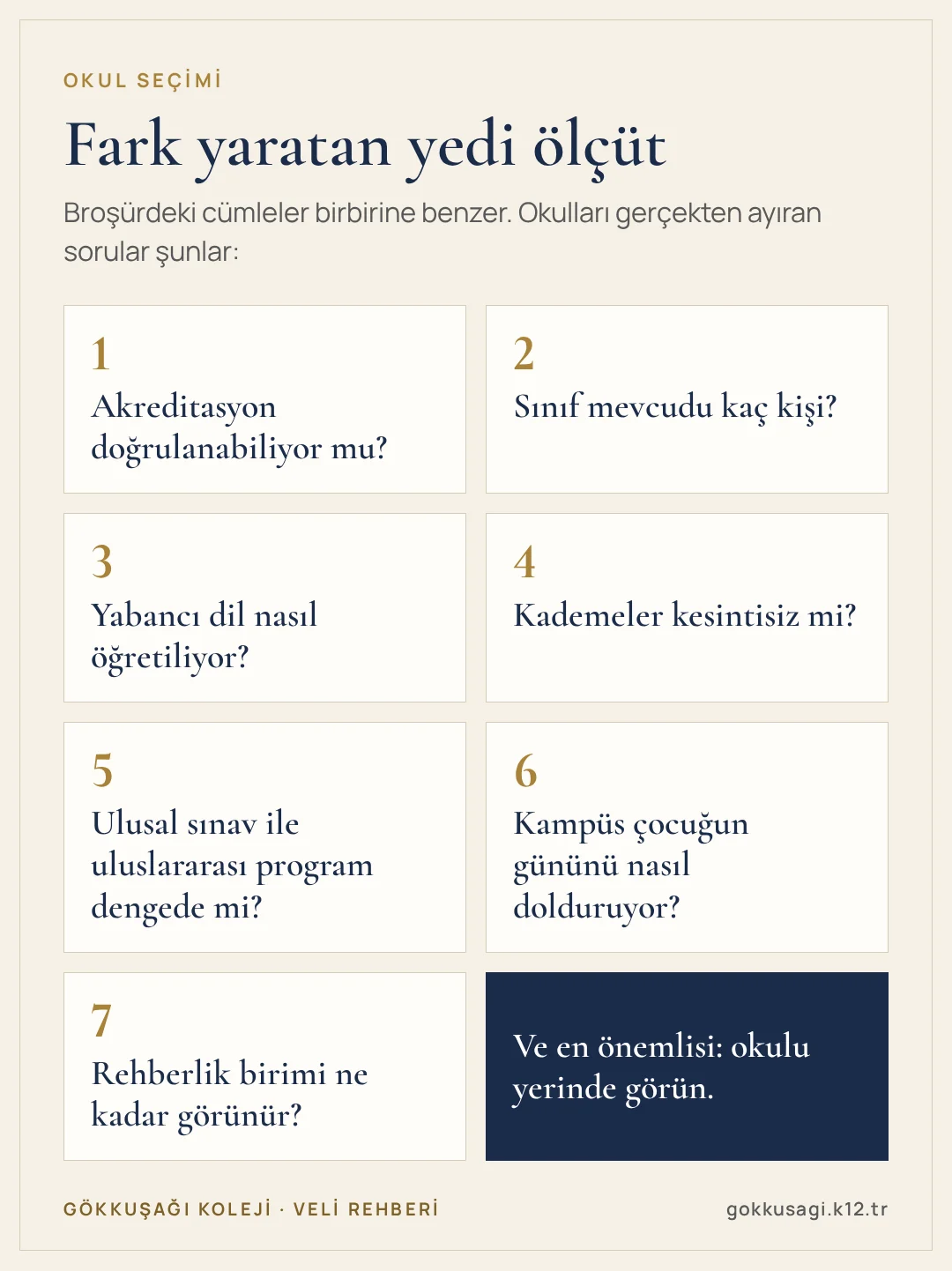
In their brochures, every school talks about strong academic staff, modern facilities and a student-centred approach. These statements are not wrong, but they do not set anyone apart either. The criteria below will help you tell schools apart in a meaningful way.
1. Can the accreditation be verified?
A school saying it offers an “international programme” and being an authorised provider of that programme are two different things. Cambridge International and the IB publish the schools they authorise on their own websites; you can check the accreditation code or certificate a school gives you against these lists. Our Ataşehir campus is registered as a Cambridge International School under centre code TR113 and is authorised for the IB Primary Years Programme (PYP); the documents are openly available on our campus page.
Checking takes a few minutes: simply type the school’s name or code into Cambridge International’s “Find a Cambridge school” search, and the school’s name into the IB’s “Find an IB World School” search. The listing shows the campus name, the city and which programmes it is authorised to teach. Doing this also shows you whether a school is attributing authorisation held under its institutional name to every one of its campuses, because authorisation is granted campus by campus.
2. How many students are in a class?
Whether a teacher can get to know every student depends directly on the number of children in the class. Instead of accepting “small classes”, ask for a concrete number. At our Ataşehir campus, classes have an average of 18 students.
3. How are foreign languages taught?
The number of English lessons per week matters, but on its own it is not a sufficient indicator. Which subjects the language is used in, whether students are grouped by level and in which grade a second foreign language begins tell you far more. Our campus offers dual foreign language education, with English starting in kindergarten.
If possible, ask to sit in on an English lesson for a short while during your visit. How much English the teacher speaks, how often students contribute and how mistakes are handled will tell you much more than a timetable.
4. Are the stages continuous?
Being able to progress from kindergarten to high school in the same school means not having to face a new school, a new environment and a new settling-in process at every transition. At our Ataşehir campus, four stages from pre-school to Grade 12 are under one roof: kindergarten (ages 4–6), primary school, middle school and high school.
5. Is there a balance between national exams and the international programme?
For families in Turkey, the LGS (the national high school entrance exam) and the YKS (the national university entrance exam) are still decisive. A good school places an international programme alongside national exam preparation, not in place of it. In middle school, Cambridge Lower Secondary runs together with LGS preparation, and in high school, Cambridge Upper Secondary runs together with YKS preparation; Checkpoint exams show where a student stands on an international scale.
6. How does the campus fill a child’s day?
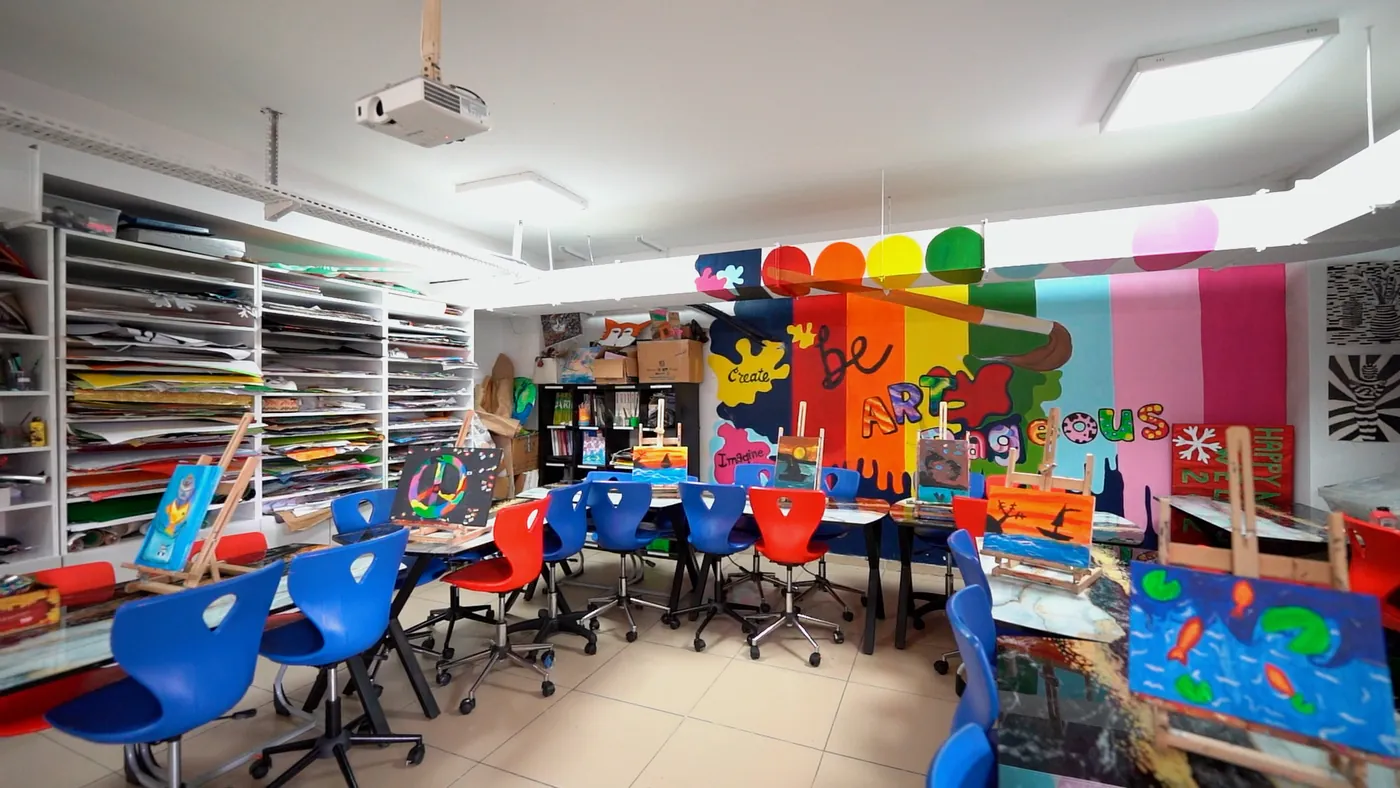
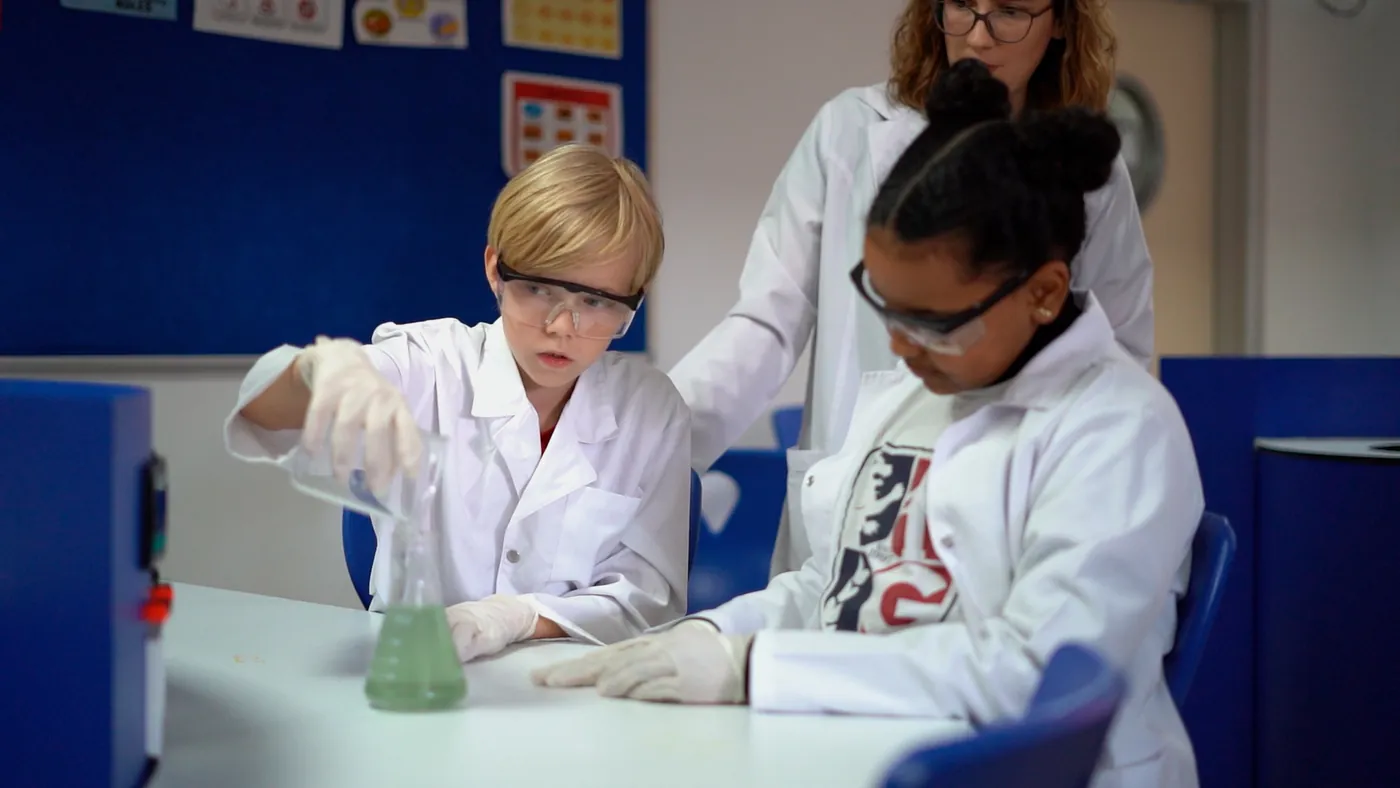
Laboratories, a library, and sports and arts spaces mean children find not only lessons at school but also their own interests. Our Ataşehir campus has a swimming pool, ice skating and archery, chemistry, physics, biology and science laboratories, a STEM workshop, a visual arts studio, a music and dance academy, a ballet studio and an amphitheatre. Meals are prepared fresh every day in the campus kitchen, and the menu is planned under the supervision of a dietitian.
7. How visible is the guidance service?
Knowing whom to talk to when your child is struggling is the least discussed but most useful side of a school. Ask how many students per class the guidance team works with, how often it meets parents and what support it offers during exam periods. We describe our approach to guidance and psychological counselling on a separate page.
A good guidance service does not step in only when a problem arises. Getting to know a student’s interests, helping them cope with exam anxiety, keeping an eye on friendships and staying in regular contact with the family are also part of its job. A few minutes’ conversation with the school counsellor during your visit quickly shows how much importance the school places on this.
The right school is not the one that lists the most facilities; it is the one your child is happy to go to every day, that you can reach, and where you can follow your child’s progress together.
What to look for at each stage
Even within the same school, each stage raises different questions. Depending on your child’s age, these are the points to focus on during your visit:
Kindergarten (ages 4–6)
At this age, what matters is less academic content and more that your child starts school feeling secure. Look at how much time is given to play, how the classroom takes shape around the children’s curiosity and how the settling-in period in the first weeks is planned. Our campus kindergarten follows the inquiry-based approach of the IB Primary Years Programme; English begins at this age as part of play and daily routines. If you are wondering whether your child is ready for school, our article The Right Age to Start Kindergarten may help.
Primary school (Grades 1–4)
Primary school is when a reading culture and core skills are built. Ask how much space books are given in the classroom, whether maths is taught with hands-on materials or only on paper, and how much students are encouraged to express their own ideas. At our campus, Cambridge Primary and the IB PYP run together at this stage.
Middle school (Grades 5–8)
In middle school, balancing two goals becomes important: strong preparation for the LGS and international academic depth. Ask how the school manages both together and how practice exams and guidance meetings are planned. At our campus, the Cambridge Lower Secondary programme and Checkpoint exams run alongside LGS preparation.
High school (Grades 9–12)
In high school the question is no longer just “which school?” but “which route to university?”. If you are considering the YKS in Turkey or applications to universities abroad, find out how the school supports both routes and in which grade university and careers counselling begins. At our Ataşehir campus, high school students follow the Cambridge Upper Secondary programme alongside the Turkish high school diploma.
When should you start looking?
At private schools, admissions for the next academic year usually open in the spring and continue until places are filled. At schools that keep class sizes limited, places can fill up early, so the most comfortable approach is to visit schools in the autumn and winter and be ready to decide by spring. This timeline gives you two advantages: you can see schools without rushing, while lessons are taking place, and you can involve your child in the process.
If you need to change schools mid-year, for example because of a move, that is also possible; in that case it is important to discuss available places and your child’s settling-in plan in advance.
Do you need to move to the European side for high school?
This question comes up most often from families considering the IB Diploma Programme. The honest answer is this: at our Ataşehir campus, high school combines the Cambridge Upper Secondary programme with YKS preparation, while the IB’s high school programme, the Diploma Programme (DP), is offered in Istanbul at our Bahçelievler campus. If the IB Diploma is a firm goal for your child, discussing it from the outset is the best way to avoid surprises later. We cover the IB options in Istanbul and the differences between the two sides of the city in detail in our article IB Schools in Istanbul.
If you are curious about the Cambridge side, our Cambridge education page and our guide to Cambridge schools in Turkey are a good place to start.
Questions to ask on a school visit
You get to know a school best by seeing it on a weekday while lessons are in progress. Take these questions with you on your visit:
- How many students will be in my child’s class, and how long have the teachers been at this school?
- Can I see your accreditation codes and certificates?
- Are English lessons grouped by level? In which grade does the second foreign language start?
- Is there a school bus from our street, and what time is the morning pick-up?
- How often does the guidance service meet parents?
- How is settling in planned for a student who joins mid-year?
- What does a student’s day look like: what happens at break, at lunchtime and after lessons?
If you are thinking of changing schools mid-year, you can find the official steps of the process in our article How Does a School Transfer Work?
- Base your search on door-to-door travel time, not on district.
- Verify any “international programme” claim with an accreditation code.
- Ask for concrete answers on class size, the language model and guidance.
- Continuity across stages removes the burden of settling in again at every transition.
- If the IB Diploma is the goal, discuss the high school stage from the start.
See our Ataşehir campus for yourself
The best way to answer the questions in this guide is to tour the campus and talk to our teachers. You can book an appointment online from our Ataşehir campus page, or fill in the information request form and our admissions team will call you. Our address: Atatürk Mahallesi, Gülnihal Sokak No:3, Ataşehir.
Frequently Asked Questions
What should I look at first when choosing a private school on the Anatolian side?
Start with the journey: how long it takes to get from your home to school, door to door, directly shapes your child’s day. Then ask for concrete answers about the accreditation of the school’s programmes, class sizes and guidance support.
Where is Gökkuşağı Schools’ campus on the Anatolian side?
We are in the Ataşehir district, at Atatürk Mahallesi, Gülnihal Sokak No:3. Our campus offers education at every stage, from pre-school to Grade 12.
Which neighbourhoods does the Ataşehir campus school bus serve?
Our school bus network covers Ataşehir, Kadıköy, Ümraniye and the surrounding neighbourhoods. If you live in a district further away, we confirm a suitable route to your home together during the admissions meeting.
Which international programmes are offered at the Ataşehir campus?
Our campus is a Cambridge International School registered under centre code TR113, delivering the Cambridge Primary, Lower Secondary and Upper Secondary programmes. In kindergarten and primary school, the IB Primary Years Programme (PYP) is also delivered with official authorisation.
How can I book a school visit?
You can choose a day and time that suits you via the online booking link on our Ataşehir campus page. Alternatively, fill in the information request form and our admissions team will call you to plan the visit together.
Is it possible to change schools mid-year?
Yes, as long as there is a place in the class, students can enrol mid-year. In that case we plan the student’s settling in and the transfer procedures together during the admissions meeting.
Is the IB Diploma Programme available on the Anatolian side?
In Istanbul, we offer the IB Diploma Programme at our Bahçelievler campus. At our Ataşehir campus, high school combines Cambridge Upper Secondary with YKS preparation.