What Is BİLSEM? Turkey’s Science and Art Centres Explained for Families

What is BİLSEM and how are children nominated? A plain guide to the official identification steps, the assessments, the programmes and the question of preparation courses.
When a teacher mentions that your child may be nominated for BİLSEM, or other parents start talking about the “BİLSEM exam”, the first question is usually the same: what is BİLSEM, and what would it mean for my child? For families who have moved to Turkey, the system can feel especially unfamiliar. This guide explains what BİLSEM (Science and Art Centres) are, how identification works under the latest guide from the Turkish Ministry of National Education (MEB), what children do at BİLSEM, and the questions parents ask most, from preparation courses to how to talk about it with your child.
What is BİLSEM?
BİLSEM stands for Bilim ve Sanat Merkezi, which translates as Science and Art Centre. These centres belong to the Ministry of National Education, and identification and teaching are run by the Ministry’s General Directorate of Special Education and Guidance Services. Their purpose is to offer additional, specialised education to pupils who have been officially identified as gifted, so that they can develop their abilities further.
The point that is most often misunderstood is this: BİLSEM is not a school. Children stay at their own school, and BİLSEM sessions take place outside school hours, on weekdays and/or at weekends. Ministry sources state clearly that BİLSEM is not an alternative to mainstream schools. In other words, BİLSEM does not replace school; it runs alongside it.
Identification covers three areas of ability:
- General intellectual ability: reasoning, problem solving, speed of learning and abstract thinking.
- Art (visual arts): interest in visual art, original expression, observation and attention to detail.
- Music: perceiving melody and rhythm, reproducing them and expressing oneself through music.
The BİLSEM Directive describes a gifted individual as someone who learns faster than their peers; stands out in creativity, art or leadership; can grasp abstract ideas; likes to work independently in areas of interest; and performs at a high level. The definition is also a reminder that ability does not look the same in every child. One child thinks in numbers, another in colours, another in sounds. If you are curious about the different faces of ability, our guide to the types of intelligence and Gardner’s theory of multiple intelligences is a good place to start.
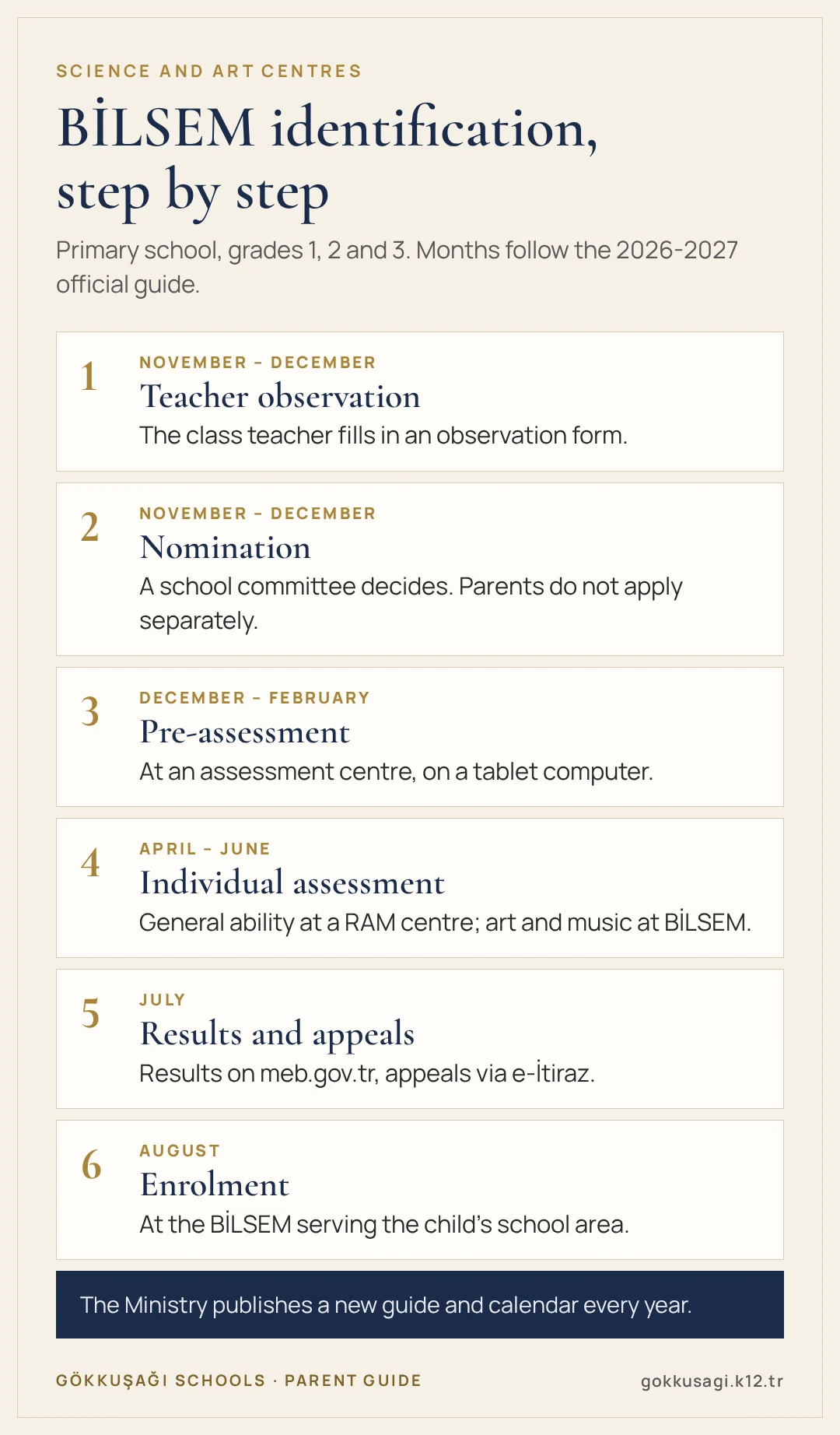
BİLSEM identification, step by step
Selection for BİLSEM follows the “Science and Art Centres Pupil Identification and Placement Guide”, which the Ministry publishes for each school year. Under the 2026-2027 guide, identification is carried out for pupils in grades 1, 2 and 3 of primary school. The grades covered have changed over the years; in the past, grade 4 was included too. That is why it makes sense to check the current guide every year.
Because identification takes place in the first years of primary school, good communication between the family and the class teacher, who observes the child every day, is especially valuable at this stage. The guide describes nomination as a process carried out in every primary school, without distinguishing between state and private schools. Whether your child attends a state school or a private primary school, the same guide applies and nomination goes through the committee at the child’s own school.
1. Teacher observation
The process begins when the class teacher completes an “Observation Form” for pupils they believe may be gifted. On the form, the teacher compares the child with peers of the same age. A pupil can be put forward in no more than two areas of ability.
2. The school committee and nomination
The forms go to the school’s guidance committee. Chaired by the head teacher, and made up of deputy heads, the school counsellor or guidance teachers, and class teachers, the committee decides which pupils will be nominated. In each grade, no more than 20 per cent of the pupils in that grade can be nominated. Parents receive a copy of a printout confirming the area in which their child has been nominated.
One important detail: parents cannot apply to BİLSEM directly. Nomination happens only through the school. Sharing your own observations with the class teacher is, of course, helpful. The class teacher and the school’s guidance service are best placed to explain how the process works at your school.
3. Pre-assessment
Nominated pupils take part in a pre-assessment. It is carried out on tablet computers at assessment centres chosen by the provincial identification committees. Each pupil’s “Assessment Entry Document” is published through e-Okul, the Ministry’s online school management system; the school announces that the documents are ready, and parents collect them and sign for them.
4. Individual assessment
Pupils who reach the score set by the Ministry in the pre-assessment are invited to an individual assessment in their area of ability. Assessments of general intellectual ability take place at Guidance and Research Centres (RAM), using test batteries chosen by the Ministry. Art and music assessments take place at BİLSEM, using criteria set by the Ministry. For pupils with special educational needs and for pupils of foreign nationality, the Ministry also determines suitable assessment tools. According to the guide, an assessor may decide not to carry out an assessment in certain cases, for example when a child’s Turkish is not at the level the test requires.
5. Results, appeals and enrolment
Results are announced on meb.gov.tr on the dates given in the calendar. Parents can appeal both the pre-assessment and the individual assessment results through the e-İtiraz (online appeals) system at eitiraz.meb.gov.tr. Pupils identified as gifted can enrol at the BİLSEM that serves the area of the school they attend. Enrolment has to be completed within the dates in the guide; under the BİLSEM Directive, a pupil who does not enrol on time loses the place.
What is the BİLSEM exam actually like?
Although parents often call it the “BİLSEM exam”, identification is not like the written tests children take at school. Its aim is not to measure how much a child has learned in lessons, but to see their potential in a particular area. The two stages are quite different:
- The pre-assessment is a group session on a tablet computer at an assessment centre.
- The individual assessment, in general intellectual ability, is the stage where an assessor works one to one with the child using tools set by the Ministry. In art and music, the child’s performance in that area is assessed. For music, the Ministry shares a sample video on orgm.meb.gov.tr showing how the assessment is carried out.
The guide states clearly that no material relating to the content of the pre-assessment or the individual assessment will be published or shared. This means that materials sold as “BİLSEM questions” are not the official assessment itself; at most, they are guesses at similar examples.
Programmes at BİLSEM
Pupils who enrol at BİLSEM move step by step through the programmes defined in the BİLSEM Directive. The programmes are designed to fit with the child’s education at school, with a project-based and interdisciplinary approach.
- Orientation programme: the starting period, when new pupils get to know BİLSEM, its programmes, their teachers and other pupils.
- Support education programme: for pupils identified in general intellectual ability, building skills such as communication, collaboration, problem solving, scientific inquiry, and critical and creative thinking across all subject areas.
- Discovering individual abilities (BYF): after support education, pupils explore different fields to find the areas they are most interested in and most able in.
- Developing special abilities (ÖYG): the stage where pupils work in depth and at an advanced level in the field they have been guided towards. Pupils identified in art or music move straight to this stage after orientation.
- Project production and management: the stage where pupils carry out projects individually or in groups, guided by a mentor teacher, in line with their interests and abilities.
Because these programmes follow a set order and timeline, Ministry guidance states that pupils identified as gifted outside the official identification process, or after it, cannot be enrolled at BİLSEM. In other words, the way into BİLSEM is this official identification process in primary school.
Are preparation courses necessary?
This is the most debated question about BİLSEM. As soon as a nomination is mentioned, many families start wondering whether to sign their child up for a course or practice tests. The worry is completely understandable: no parent wants their child to miss an opportunity.
The “Frequently Asked Questions about BİLSEM and the Identification Process” document shared by Ministry institutions is clear on this point: no preparation is needed for identifying giftedness. Because the process is based on discovering the abilities a child already has, work done with an “exam preparation” mindset is not recommended.
The reasoning is simple. Identification aims to see how a child thinks. If a child has spent months practising particular question types, the result may reflect the practice more than their real way of thinking. The child could then be placed in a programme that does not match their needs and find it hard going. There is an emotional side too: putting a child in the first years of primary school through weeks of preparation for a “big exam” can hand them a very adult kind of worry.
That does not mean doing nothing. Reading books, playing board and strategy games, visiting museums, drawing, listening to music and following their questions together are good for every child. These are not exam preparation; they are part of a rich childhood and are valuable whatever the BİLSEM result. For a child who is not used to tablets at all, a short introduction to the device before assessment day can make the setting feel less strange; the goal is simply to show the device, not to practise questions.
BİLSEM identification wants to see how a child thinks, not how hard they have been drilled.
How to explain BİLSEM to your child
How a child experiences the process depends largely on how the adults around them frame it. A few principles help:
- Simple, calm language: “Your teacher noticed that you are very curious about some things. One day you will answer some questions on a tablet. It is completely normal not to know some of them; that is the same for everyone.”
- Curiosity rather than “exam”: not presenting the result as a measure of success or failure helps the child stay relaxed.
- No rewards or punishments: promises such as “If you pass, we will buy you a bike” put unnecessary weight on a child’s shoulders.
- No comparisons with siblings or friends: every child’s abilities are different, and comparison turns the process into a race.
- Noticing our own anxiety: children easily pick up tension in a parent’s voice. A calm adult is one of the best supports a child can have.
If your child is upset after the result, listening without brushing the feeling aside and recognising their effort can help. We have written in detail about which words reassure an anxious child in our guide on what to say to a child with exam anxiety.
What if my child is not identified?
If your child is not identified this year, it is important to read the result correctly. Identification is an assessment carried out on a particular day, with particular tools, in only three areas. Many strengths, such as sport, leadership, languages, social skills or practical skills, fall outside that frame. A child being tired, unwell or nervous on the day can also affect the result.
According to Ministry guidance, a pupil who is nominated but does not earn a place can be nominated again in a later year, provided they meet the conditions in that year’s guide. For example, a pupil nominated in grade 1 may be assessed again in a later year if the conditions allow.
Most importantly, it helps to remind both ourselves and our children that one result does not decide a child’s worth or future. Every child has sides waiting to be discovered; our article on hidden talents may give you some ideas. School clubs, art and sport also show that there are many ways, beyond BİLSEM, to nurture a child’s strengths.
Signs of giftedness: what might stand out?
Parents often ask whether their child shows signs of giftedness. There is no checklist that can answer this with certainty; giftedness is identified only through the official process, using assessment tools applied by specialists. Still, the observation form the Ministry prepares for teachers gives an idea of what teachers look for. Some of the statements on the form are:
- General intellectual ability: asking questions to learn about a new topic, quickly linking cause and effect, remembering things learned long ago, making unusual connections between seemingly unrelated ideas, persisting until a task is finished.
- Art: spending long stretches on visual art without getting bored, expressing a topic from an original point of view, including detail and proportion in drawings, combining different materials into original designs.
- Music: repeating a melody exactly as heard, moving rhythmically along with music, telling low and high sounds apart, turning everyday objects into musical instruments.
Almost every child shows a few of these from time to time. What matters is how clearly the behaviour stands out compared with peers and how long it has continued, and the teacher who sees the child in class every day is best placed to judge that. It is also common for a child who is far ahead in one area to be at the same level as their peers in another. Every child learns differently; to understand how your child learns, you may also like our guide to learning styles.
Balancing school and BİLSEM
For a child who gains a place at BİLSEM, the weekly routine changes. Going to BİLSEM outside school hours, after school on weekdays or at weekends, also affects the family’s travel and time planning. A few things make the balance easier:
- Rest and play: keeping room for free play and rest between school, homework, BİLSEM and other activities protects a child’s enthusiasm.
- Communication with school: the BİLSEM Directive says that education is carried out through cooperation between the pupil’s school, the parents and BİLSEM. Keeping the class teacher and the school’s guidance service informed about BİLSEM work helps the school think about suitable enrichment as well.
- Regular attendance: attendance at BİLSEM is monitored, and a pupil who goes over the absence limit can lose their place. Making a realistic plan from the start prevents problems later.
- Listening to the child: BİLSEM is an opportunity, not an obligation. Talking with your child from time to time about whether they enjoy the programme matters.
The aim of BİLSEM is not to take children away from school, but to deepen the curiosity that starts at school in other settings. When school and BİLSEM complement each other, a child keeps learning with peers and also finds a setting that stretches them in their area of interest. For a view of ability that does not reduce it to a single result, the types of intelligence and the multiple intelligences approach are a helpful reminder.
In short
- BİLSEM (Science and Art Centres) are run by Turkey’s Ministry of National Education; they offer extra education outside school hours to pupils identified as gifted and do not replace school.
- Identification covers general intellectual ability, art and music; under the 2026-2027 guide it is for pupils in grades 1, 2 and 3 of primary school.
- The process starts with the class teacher’s observation form; the school committee decides on nomination, and parents do not apply separately.
- The pre-assessment is done on a tablet; pupils who reach the Ministry’s score go on to an individual assessment.
- The Ministry states that no preparation is needed and does not recommend working with an “exam preparation” mindset.
- Not being identified does not mean a child lacks ability; ability cannot be measured by a single assessment.
Frequently Asked Questions
In which grade is BİLSEM identification done?
Under the Ministry’s 2026-2027 guide, BİLSEM identification is for pupils in grades 1, 2 and 3 of primary school. As the grades have varied in past years, it is worth checking the current guide, which is published every year.
Can pupils at private schools take part in BİLSEM?
Parents do not apply to BİLSEM; pupils are nominated through their own school, based on the class teacher’s observation and the school committee’s decision. The guide describes this process for every primary school without distinguishing between state and private schools. Your child’s school guidance service can tell you how the process works there.
How does the BİLSEM exam work?
Identification has two stages. First, a pre-assessment is held on tablet computers at assessment centres. Pupils who reach the score set by the Ministry go on to an individual assessment: at Guidance and Research Centres (RAM) for general intellectual ability, and at BİLSEM for art and music.
Is there a fee for BİLSEM?
BİLSEM centres are state institutions under the Ministry of National Education, and identification is run by the Ministry. The current identification guide does not mention any application or assessment fee for parents. If in doubt, the provincial or district directorate of national education can confirm.
Does my child need to prepare for BİLSEM?
According to guidance shared by Ministry institutions, no preparation is needed for identifying giftedness, and work done with an “exam preparation” mindset is not recommended. Everyday life full of books, games, art and music supports every child’s development, whatever the result.
Does my child change school after joining BİLSEM?
No. BİLSEM is not a school; the pupil stays at their own school. BİLSEM sessions take place outside school hours, on weekdays and/or at weekends. An identified pupil enrols at the BİLSEM serving the area of the school they attend.