Exam Anxiety: What to Say to Your Child, and What Not to Say
Some well-meant words can make an anxious child feel worse before an exam. What helps before the exam, on the morning itself and when the results arrive, and what is best avoided.
The night before an exam your child cannot sleep, leaves breakfast untouched in the morning and asks, “What if I can’t remember anything?” To reassure them, you say the first thing that comes to mind: “Don’t worry, you’ll be fine.” Yet their face does not relax. With exam anxiety, how we say something matters as much as what we say. In this article we look at well-meant phrases that do not help an anxious child, what you can say instead, and what you can do at different stages of the exam period.
First, know this: a little anxiety is normal
A slight feeling of tension before an exam is actually the body’s way of getting ready. It sharpens focus, nudges a student to study and keeps the mind alert during the exam. A student who feels no anxiety at all may simply not care about the exam.
The problem comes when anxiety grows so strong that it stops a child from showing what they know. The child knows the material, yet their “mind goes blank” in the exam, they struggle to understand the questions as they read them and cannot manage their time. Exam anxiety is not a lack of knowledge; it is an emotional load that makes knowledge harder to reach. The distinction matters, because the advice “Study harder” does not lighten that load and often makes it heavier.
What does exam anxiety look like?
Anxiety shows itself differently in every child. These are the signs families most often notice:
- In the body: stomach aches, headaches, nausea, trouble sleeping, changes in appetite, frequent trips to the toilet on the morning of the exam.
- In thoughts: worst-case scenarios such as “It’s definitely going to go badly”, “Everyone is better than me”, “If I can’t do it, everything is over”; an endless stream of “What if…?” questions.
- In behaviour: putting off studying or, the opposite, studying non-stop and being unable to rest; getting irritable, crying or withdrawing when the exam comes up; not wanting to go to school.
It is common to see these signs now and then during exam periods. If they last a long time, continue outside exam periods or clearly affect daily life, it is time to seek support from a specialist, and the school counselling service is the first place to turn. We will come back to this at the end of the article.
Well-meant phrases that can increase anxiety
None of the phrases below are said with bad intentions. Most are meant to comfort or motivate the child. But an anxious child may hear them differently.
“Don’t worry, you’ll be fine.”
It sounds reassuring. But if the child does not feel ready, this phrase sends the message “Your feeling is wrong” and leaves them on their own. It also leaves unanswered the question of what happens if they are not fine.
“This exam will decide your future.”
It is said to convey how serious the exam is. But it places an unbearable weight on the shoulders of a child who is already anxious. No single exam determines a person’s future on its own.
“Your brother / cousin / friend got such-and-such a score.”
Comparison shifts the child’s attention away from the subject and onto someone else. It feeds the thought “I’m not good enough”.
“After all that studying, if you get a bad result…”
This turns effort into a kind of debt. The child starts to experience the exam as a bill to be paid to the family.
“Calm down.” / “Don’t exaggerate.”
Telling an anxious person to “calm down” does not show them how to calm down. It can make them feel that their emotions are being dismissed.
“How many did you get right?” (the moment the exam ends)
Asking about the result as soon as the exam is over tells the child, “The score is what matters most to me.” At that moment the child has not yet made sense of their own feelings.
An anxious child does not need more pressure; they need solid ground to stand on.
What you can say instead
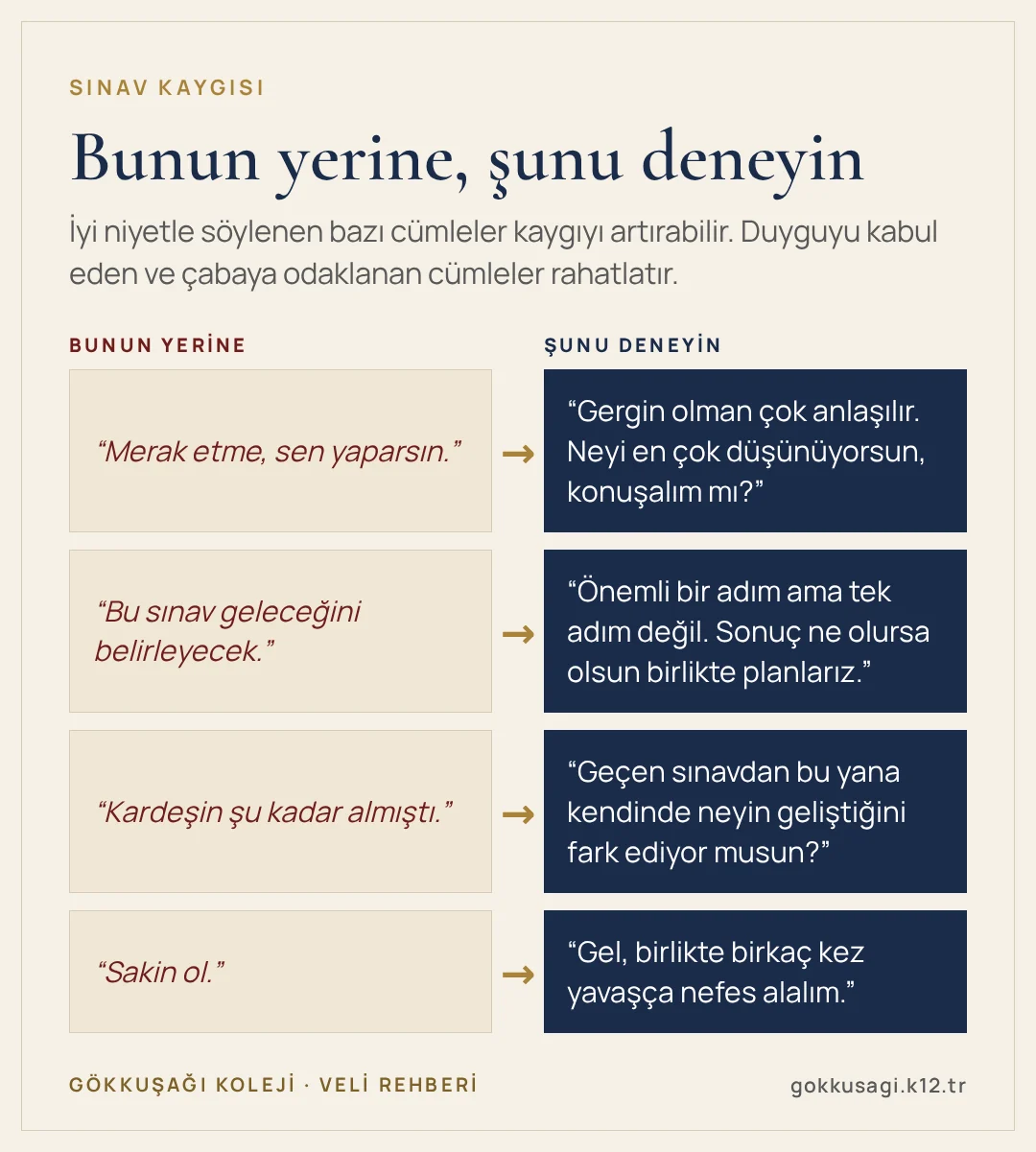
Phrases that ease anxiety have something in common: they acknowledge the feeling, shift the focus from the result to the effort and reassure the child, “Whatever happens, I’m with you.”
| Instead of… | Try this |
|---|---|
| “Don’t worry, you’ll be fine.” | “It’s completely understandable that you’re nervous. What are you thinking about most? Shall we talk?” |
| “This exam will decide your future.” | “This exam is an important step, but it isn’t the only one. Whatever the result, we’ll plan the next step together.” |
| “Your brother got such-and-such.” | “Have you noticed what you’ve got better at since the last exam?” |
| “After all that studying…” | “I’m proud of the effort you’ve put in this term. The exam result won’t change that.” |
| “Calm down.” | “Come on, let’s take a few slow breaths together.” |
| “How many did you get right?” | “How are you feeling? If you like, let’s have something to eat now and talk later.” |
There is no need to memorise these phrases. What matters is the heart of the message: your worth does not depend on an exam result, and you are not alone in this.
In the weeks before the exam
Make anxiety something you can talk about
Anxiety grows when it goes unspoken. Rather than raising the exam only with “Have you studied?”, ask from time to time, “How are you feeling about this exam?” As you listen to your child’s fears, resist the urge to come up with solutions straight away; try to understand first. Sometimes simply being heard is a relief.
Focus on what they can control
A child cannot control how hard the exam is, the other students or the result. But they can control their study plan, their sleep and how they get ready on the morning of the exam. Anxiety grows when it fixes on things that cannot be controlled. Steering the conversation towards “So what is in your hands?” gives the child a sense of strength.
Keep the routine
The exam period should not be a time when the rest of life stops. Regular sleep, regular meals, some movement, however short, and time with friends are the foundations of coping with anxiety. In exam week it is usually better to cut back on sport, music or a favourite hobby rather than drop it altogether. For ideas on balancing study and rest, see the suggestions in our article on time management for children.
Notice your own anxiety
Children read their parents’ emotions very well. Your worries about the exam show in your face, your tone of voice and the questions you keep asking, even if you never put them into words. Noticing your own anxiety and managing it separately from your child is one of the greatest kinds of support you can give. Our article on stress at home and its effect on children may also help.
The night before and the morning of the exam
- No new topics on the last night. A light review is enough. Studying late into the night reduces concentration the next day.
- Get everything ready the evening before. Pencil, rubber, ID, water bottle, clothes… A rushed morning increases anxiety.
- Don’t force breakfast, but don’t let them skip it. For a child with an upset stomach, something light that they like is enough.
- Don’t talk about the exam on the way. Calm music or an everyday chat is better than last-minute questions and advice.
- Keep the goodbye short and warm. A sentence that has nothing to do with the result, such as “Do your best, and tonight I’ll make your favourite dinner”, reminds your child that there is life after the exam.
When the results arrive
The result may be better or worse than expected. Either way, your reaction shapes how your child will approach the next exam.
When the result is good
Direct your praise not only at the score but at the effort and the process: “Your steady work has paid off” gives more lasting motivation than “You’re so clever”. Effort is in the child’s hands, so it can be repeated in the next exam.
When the result is disappointing
Make room for feelings first. Let your child experience their disappointment, anger or sadness. Analysis and planning come after emotions have settled. The next day you can look at these questions together: What went well? Where did you struggle? What would you like to do differently next time? For ideas on moving forward after a low mark, see our article advice for students who get low marks in exams.
Small differences by age
- In primary school: the idea of a test is new. It is enough to describe a test as “a way for the teacher to see what you’ve learnt” and not to present it as a big event. At this age anxiety often shows itself physically, for example as a stomach ache.
- In middle school: comparisons with friends begin. Help your child focus on their own progress. On the road to big exams such as the LGS, Turkey’s national high school entrance exam, the balance between routine and rest is especially important.
- In high school: teenagers see the result as linked to their own future. Here a parent’s role is less about directing and more about accompanying: listening, thinking through the options together and reminding them that a single exam is not the only path.
When is specialist support needed?
In the following situations it is right to talk to the school’s counselling service or a specialist:
- if physical symptoms recur often and continue outside exam periods,
- if the child does not want to go to school in order to avoid exams,
- if changes in sleep and appetite last for weeks,
- if anxiety turns into intense episodes resembling panic attacks,
- if the child expresses hopelessness or talks about harming themselves (in this case, seek professional help without delay).
In short
- A little anxiety is normal and helps with preparation; the problem is when anxiety stops a child from showing what they know.
- “Calm down”, “This exam will decide your future” and comparisons with others can increase anxiety, even when well meant.
- Phrases that ease anxiety acknowledge the feeling, shift the focus to effort and offer unconditional support.
- Regular sleep, meals and movement; no new topics on the last night; no exam talk on the morning of the exam.
- Whatever the result, make room for feelings first; planning and analysis can come later.
- If symptoms last a long time or affect daily life, talk to the school’s counselling service and, if needed, a specialist.
Frequently Asked Questions
What is exam anxiety?
Exam anxiety is a state of tension before and during an exam that is intense enough to make it hard for a person to show what they know. It can appear as physical symptoms such as stomach aches and sleeplessness, as thoughts such as “it’s definitely going to go badly”, and as behaviours such as procrastination or avoidance. Mild tension, on the other hand, is normal and helps with preparation.
What should you say to a child with exam anxiety?
Phrases that acknowledge the feeling, value the effort and offer unconditional support work best: “It’s completely understandable that you’re nervous, shall we talk?”, “I’m proud of the effort you’ve put in this term”, “Whatever the result, we’ll plan the next step together.”
What should you not say to a child with exam anxiety?
“Calm down”, “Don’t exaggerate”, “This exam will decide your future”, phrases that compare them with others, and asking “How many did you get right?” the moment the exam ends can all increase anxiety, even when well meant.
How can I support my child on the morning of an exam?
Get everything ready the evening before, offer a light breakfast, don’t talk about the exam on the way and say goodbye with a short, warm sentence that has nothing to do with the result. A calm atmosphere helps more than last-minute advice.
What should I do if the exam result is disappointing?
First let your child experience their feelings; analysis and planning should come once emotions have settled. The next day, talk together about what went well, where they struggled and what they would like to do differently next time.
When should you see a specialist about exam anxiety?
If symptoms continue outside exam periods, the child does not want to go to school, changes in sleep and appetite last for weeks or there are intense panic-like episodes, you should talk to the school’s counselling service and a specialist. If the child talks about hopelessness or harming themselves, seek professional help without delay.