Getting Ready for School in the Morning: How to Build a Stress-Free Routine

Are school mornings all rush and arguments? Practical tips on preparing the night before, age-appropriate morning routines, visual checklists, breakfast and those running-late crises.
It is 7.40. A sock has gone missing, breakfast is half-eaten, the school bus is at the door and everyone's voice has risen a little. In many families, school mornings are the tensest moment of the day. Yet the way the morning goes also shapes the mood a child carries into school. The good news is that the secret of a stress-free morning usually lies not in the morning itself but in the evening before. In this article we have gathered the small habits that calm mornings down, routine suggestions by age and practical solutions to common problems.
Why a routine?
Children feel safe when they know what is coming. A few steps that follow the same order every morning mean a child does not have to wonder "what do I do now?". That eases both their mind and yours. A routine replaces the dozens of instructions given afresh every morning. As "Have you brushed your teeth?", "Where is your bag?" and "Put your shoes on!" are heard less often, mornings become calmer.
A routine also builds independence. A child who dresses themselves, packs their bag and keeps track of time enjoys a small success every morning. Starting the day with that feeling is one of the best ways to begin on a positive note. If morning tension has turned into reluctance to go to school for some time, it helps to talk to the school counselling service.
The morning starts the night before
Much of the morning stress comes from leaving jobs that could have been done in the evening until the morning. Fifteen minutes set aside after dinner can transform the following morning.
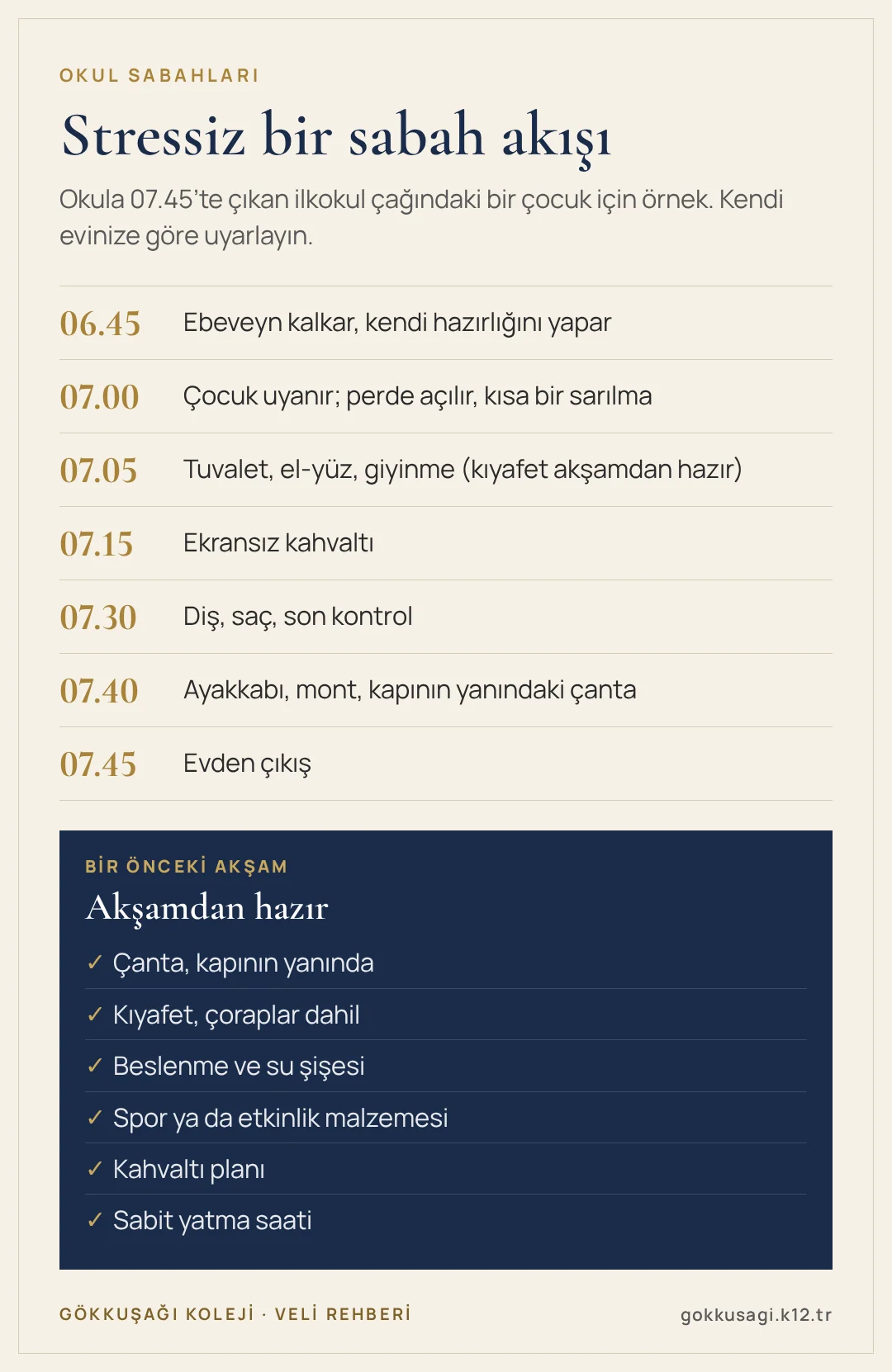
Evening preparation checklist
- School bag: The bag is packed the night before according to the timetable and placed by the door. If there is a form to sign or something to bring in, it is dealt with that evening.
- Clothes: The next day's clothes, socks included, are chosen and laid out the night before. Offering younger children two options moves the morning argument to the evening, a calmer moment.
- Snack and water bottle: The snack or water bottle going to school is prepared the night before.
- Sports or activity kit: Check the weekly timetable so that extras such as PE kit or a musical instrument are not forgotten.
- Breakfast plan: What will be eaten is decided the night before; if possible, the table is partly laid.
Sleep: the real start of the morning
For a child who struggles to wake up, the real problem is usually not the morning but going to bed late. The habits that make mornings easiest are a fixed bedtime that allows for age-appropriate sleep, no big differences between weekdays and weekends, and switching off screens before bed. For children with a phone, it is also important that the device stays outside the bedroom at night. We discuss this in detail in our article Your Child's First Phone.
Morning routines by age
Pre-school and the first years of primary school
At this age children find it hard to grasp time in the abstract, so making the routine visual works very well. Prepare a list with a small picture for each step: wake up, toilet, wash face and hands, get dressed, breakfast, teeth, shoes and coat. Making the list together with your child and putting it up somewhere visible gives them a sense of ownership. Being able to tick off each step as it is done can turn the morning into a little game.
The later years of primary school
At this age a child can largely run the routine on their own. You can turn the picture list into a written one and ask them to set their own alarm. Your role is less a reminder and more a supporter. If there is a step they struggle with, for example always dawdling while getting dressed, talk it through together and look for a solution.
Middle school and high school
In adolescence the body clock shifts; teenagers naturally want to go to sleep later and wake up later. At this stage the morning routine is largely the teenager's own responsibility. Give them room to build their own routine, support them in making evening preparation a habit and, instead of lecturing in the morning, offer a calm breakfast table. Our article on time management for children may also give you ideas about a young person's ability to manage their own time.
A sample morning schedule
The schedule below is an example for a primary-school child who needs to leave for school at 7.45. Adapt it to your home and your child's pace.
| Time | Step |
|---|---|
| 06.45 | Parent gets up and gets ready |
| 07.00 | Child is woken; curtains opened, a few minutes of cuddles or chat in bed |
| 07.05 | Toilet, washing, getting dressed (clothes ready from the night before) |
| 07.15 | Breakfast |
| 07.30 | Teeth, hair, final check |
| 07.40 | Shoes and coat; bag collected from beside the door |
| 07.45 | Out of the house |
Always leave a buffer of five to ten minutes at the end of the schedule. A missing sock or a spilt glass of milk is a small hiccup if there is a buffer, and a crisis if there is not.
Breakfast: short but real
Breakfast matters if a child is to start the first lessons with energy. But some children simply have no appetite in the morning. In that case, rather than insisting on a big breakfast, it is more realistic to offer a few favourite, easy-to-eat options or prepare a light snack they can take to school.
The breakfast table may be the only shared moment of the day. Switching off screens and chatting for a few minutes helps the child set off for school in a good mood and strengthens family bonds. Talking about the day's plans or a happy memory, rather than quizzing them about homework or tests, softens the atmosphere.
Morning screens: a short rule, a big difference
In the morning, the television, tablet or phone is what breaks a routine most easily. Once a screen goes on, dressing slows down, breakfast is left half-eaten and the "just one more minute" bargaining begins. For many families the most effective rule is simple: no screens in the morning. Or at least, the screen goes on as a small reward only once everything is ready and there is still time left.
A calm morning is the most valuable thing your child carries through the school gate.

Common problems and solutions
"They can't wake up"
First look at bedtime. Soften the moment of waking too: opening the curtains, calling them a few minutes earlier and a short chat at the edge of the bed work far better than waking a child abruptly. For older children, setting their own alarm and placing it a little away from the bed can help.
"They dawdle"
Dawdling is usually not stubbornness but difficulty sensing time. A visual timer, an hourglass or concrete measures such as "let's be dressed by the end of this song" make time visible to young children. Rather than prompting every step separately, point them to the list: "What's next on your list?"
"An argument about clothes every morning"
Move the decision to the evening and limit the choice. Choosing between two outfits gives the child a say while keeping the discussion short.
"I don't want to go to school"
Occasional reluctance is normal; sometimes it is just tiredness or the effect of returning after a holiday. But if morning tummy aches, tears or not wanting to go to school happen often, there may be a school-related problem underneath. In that case, talk to your child at a calm moment, away from the morning rush, and speak to the class teacher or the school's guidance and counselling service. To understand what your child is experiencing at school, you can use the suggestions in our article on questions to ask your child after school.
"Siblings distract each other"
Each child having their own list and, if possible, different time slots for the bathroom and getting dressed reduces friction. In some families, giving the older sibling the job of "helping" the younger one works very well.
A routine takes time to settle
A new routine does not work perfectly from day one. The first week or two will need reminders and patience. When you apply the routine consistently for a few weeks, you will see your child doing the steps more and more on their own. Noticing and mentioning the mornings that go well also strengthens the routine: "You got everything ready yourself this morning and we left so calmly." For the general principles of building habits, have a look at our article Helping Children Build Good Habits.
In short
- A stress-free morning starts the evening before: have the bag, clothes, snack and breakfast plan ready in advance.
- A fixed bedtime and a screen-free bedroom at night are the habits that make waking up easiest.
- A visual routine chart works for young children; for older ones, a schedule they set up themselves.
- Leave a five-to-ten-minute buffer at the end of the schedule so small hiccups do not turn into crises.
- A no-screens-in-the-morning rule is one of the simplest rules for protecting the routine.
- If reluctance to go to school keeps recurring, talk away from the morning rush and get in touch with the school.
Frequently Asked Questions
What does a good morning routine for children look like?
It should consist of a few simple steps in the same order every morning: waking up, toilet and washing, getting dressed, breakfast, brushing teeth, shoes and coat. Preparing the bag and clothes the night before, a visual list for young children and a five-to-ten-minute buffer at the end make the routine easier.
What should I do if my child struggles to wake up in the morning?
First review bedtime and night-time screen use; the problem usually starts at night, not in the morning. Soften the moment of waking by opening the curtains, having a short chat and calling them a few minutes earlier. Older children can set their own alarms.
How can I speed up a child who dawdles in the morning?
Dawdling usually comes from difficulty sensing time. Use concrete measures such as a visual timer, an hourglass or the length of a song, and instead of prompting every step, point your child to their routine list.
Should I make a child who does not want breakfast eat?
Rather than insisting on a big breakfast, offer a few favourite, easy-to-eat options or prepare a light snack they can take to school. Turning the breakfast table into a short, screen-free chat also has a positive effect on appetite and mood.
Should I allow screens in the morning?
For many families the most effective rule is no screens in the morning. Screens slow down dressing and breakfast. If you wish, you can switch one on as a short reward once everything is ready and there is still time left.
What should I do if my child refuses to go to school every morning?
Occasional reluctance is normal. But if tummy aches, tears or not wanting to go to school recur often, talk to your child at a calm moment away from the morning rush and speak to the class teacher or the school's guidance and counselling service.