Your Child’s First Phone: When, and With What Rules?

What age should a child get a phone? Instead of a fixed age: the signs of readiness, choosing the first device, a family phone agreement and what to watch for in the first months.
“I’m the only one in my class without a phone.” For many parents, the first-phone question starts with exactly this sentence. On one side there is the wish to be able to reach your child and the worry that they will fall behind their friends; on the other, concerns about screen time, social media and safety. Rather than giving a fixed age, this article sets out the questions that will help you judge whether your child is ready for a phone, what to consider when choosing the first device, and the rules you can agree on together at home.
What age should a child get a phone?
There is no single answer that fits everyone. A phone that meets a real need for one family at 10 may be unnecessary for another even at 14. What decides it is not age on the calendar but the answers to three questions:
- Need: Why does your child actually need a phone?
- Readiness: How well do they follow rules, take responsibility and tell you when they run into a problem?
- Framework: Are you ready to set clear rules for how the device is used, and to follow them through?
In many families the phone question comes up somewhere between the end of primary school and the start of middle school. Children begin to move about more independently, take the school bus or public transport on their own, and join after-school activities. The need to stay in touch at this stage is real. But a need to stay in touch is not the same thing as an unrestricted smartphone. Separating the two makes the decision easier.
Is your child ready? Questions to ask yourself
- Do they usually look after their belongings without losing them?
- Can they keep to the existing screen-time rules (tablet, television, games console) without major arguments?
- When something goes wrong, for example when they see something upsetting online, do they tell you?
- Are they mature enough to write messages with other people’s feelings in mind and to notice when a joke becomes hurtful?
- Do they struggle to stick to bedtime and homework time? Would a phone upset that balance?
- Can they explain in their own words what the phone is needed for?
If you can answer “yes” to most of these questions, your child may be ready for a supervised start. If several answers are “not yet”, it may be wiser to postpone the phone or begin with a more limited device. Remember that “not now” does not mean “never”. Telling your child which skills will bring the phone back onto the table also gives them a goal.

The first device: does it have to be a fully open smartphone?
The first phone does not have to be a smartphone with every feature switched on. For most families a step-by-step approach based on need works better:
- Smartwatch or basic phone: A good first step for younger children who only need calls and text messages. It offers safety features such as location sharing but does not open the door to the internet, social media and games.
- Restricted smartphone: A phone on which parental controls limit app downloads, internet access and usage time. It covers basic needs such as messaging, maps and music.
- More independent use: As the child shows responsibility, the limits are widened gradually. This should be discussed not as a reward but as the result of trust that has been earned.
A step-by-step path lets your child get used to the digital world gradually, and lets you see what is working at each stage.
Technical settings to put in place before handing over the phone
- Parental controls: Set up the family and parental control settings offered by the phone’s operating system. Make app downloads subject to your approval and filter out content that is not age-appropriate.
- Screen-time limits: Set a daily usage limit and a “downtime” period that blocks use at night.
- Privacy settings: Limit location sharing to the family only, and review camera and microphone permissions.
- Purchase lock: Require a password for in-app purchases.
- Emergency contacts: Add to the contacts list the family members and close relatives who can be reached when needed.
These settings are a safety net, but they are not enough on their own. The real protection is open communication with your child. For the basic rules of online safety, see our article How to Stay Safe Online.
A family phone agreement
Rather than introducing rules one by one after the phone has arrived, it helps a great deal to put them in writing together before you hand it over. A family phone agreement makes the rules clear from the outset, reduces arguments and gives your child the sense that “we set these rules together”. The points below can be a starting point; adapt them to your own family.
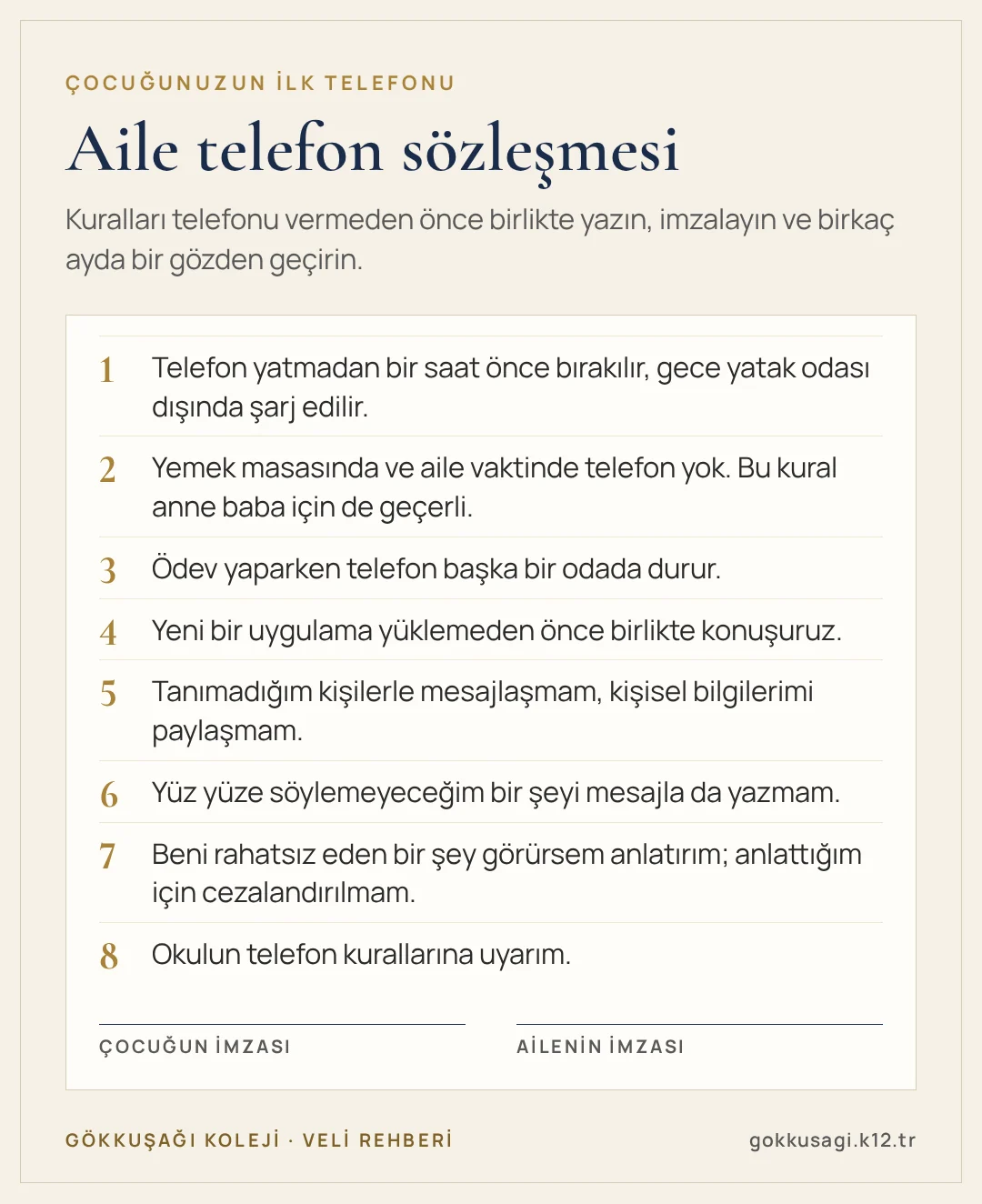
The point “I will not be punished for telling” is especially important. If a child believes that telling you about a problem will mean losing the phone, they will not tell you. Yet your greatest protection is their knowing that they can come to you.
Social media is a separate decision
Getting a phone and opening a social media account are not the same decision. Most of the popular social media platforms require users to be at least 13 in their terms of use. That is a minimum; it does not mean every child who turns 13 is ready for social media.
Social media carries risks that differ from those of the phone itself: comparison through likes and follower counts, constant notifications, content that is not age-appropriate and contact with strangers. So it makes sense to treat social media as a separate stage, to set up the privacy settings together when an account is opened, and to keep an eye on things together in the early period. For the signs of online bullying, our article Peer Bullying: How Can We Protect Our Children? can also help.
What to watch for in the first months
Sleep
Having the phone in the bedroom at night is one of the most common problems. Notifications, the urge for “just one more video” and screen light all delay sleep. A child who has not slept well also finds it harder to concentrate in lessons. Charging the phone outside the bedroom at night is one of the easiest rules for families to apply, and one that makes the biggest difference.
School and homework
Find out your school’s phone rule and support it at home. Keeping the phone in another room during homework noticeably reduces distraction. If you notice a change in your child’s homework habits, do not hesitate to talk to their teacher.
Behaviour and mood
Signs such as intense anger when the phone is taken away, avoiding family time, changes in sleep and appetite, or drifting away from activities they used to enjoy can indicate that phone use has lost its balance. If so, review the rules together and, if necessary, speak to the school’s guidance and counselling service. On excessive attachment to the phone, our articles What Is Nomophobia? and the benefits of setting screen time for children may give you some ideas.
Leading by example
Children learn rules more from what we do than from what we say. A parent who checks their phone at the dinner table will find it hard to enforce a “no phones at the table” rule. When family rules apply to everyone, children accept them more easily.
A first phone is not the handover of a device but the start of a long road you will walk together.
Update the rules as they grow
Rules set for a 10-year-old may feel too strict for a 14-year-old. It is natural, and necessary, for rules to loosen with age. Sitting down every few months to talk about what is working and what needs to change helps a teenager take on responsibility. The aim is to raise a young person who, by the end of adolescence, can use a phone in a balanced way on their own.
In short
- There is no single right age for a child’s first phone; need, readiness and family rules are what decide it.
- The first device does not have to be a fully open smartphone; you can start with a smartwatch or a restricted phone.
- Set up parental controls, screen time and privacy settings before handing over the phone.
- Turn the rules into a written family phone agreement and review it regularly.
- Social media is a separate decision; the platforms’ age limit of 13 is a minimum.
- Charging the phone outside the bedroom at night is one of the easiest and most effective rules.
Frequently Asked Questions
What age should a child get a phone?
There is no single age that applies to everyone. What matters is whether the child genuinely needs a phone, how well they follow rules and take responsibility, and whether the family is ready to set clear rules and follow them through. In many families the question comes up between the end of primary school and the start of middle school.
Should the first phone be a smartphone?
Not necessarily. For younger children who only need to stay in touch, a smartwatch or basic phone is a good first step. Later you can move to a smartphone restricted by parental controls, widening the limits gradually as the child shows responsibility.
What should a family phone agreement include?
The core points are bedtime and where the phone charges overnight, phone use at meals and during homework, installing new apps, contact with strangers, not sharing personal information, telling the family when something upsetting comes up, and reviewing the rules regularly.
Can my child open a social media account?
Most popular social media platforms require users to be at least 13 in their terms of use. That is a minimum; not every 13-year-old is ready for social media. It is best to treat social media as a separate decision from the phone and to set up the privacy settings together.
Should the phone stay in the child’s room at night?
It is not recommended. Notifications and screen use can delay sleep. Putting the phone away before bedtime and charging it overnight outside the bedroom, in a shared space, is one of the easiest rules to apply and one that makes the biggest difference.
What should I do if phone use gets out of control?
If you see signs such as intense anger when the phone is taken away, changes in sleep and appetite, or withdrawal from family and friends, review the rules together. If the situation continues, talk to the school’s guidance and counselling service and, if necessary, a specialist.